
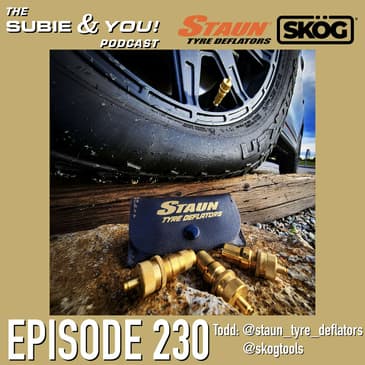
Todd joins us to talk about Staun Tyre Deflators, how they work, and why they matter. He also talks about his own brand, SKOG Tools and how they complement Staun Tyre Deflators.
Links from the show, links to sponsors and discount partners, and ways to support the podcast:
Staun Tyre Deflators
https://www.instagram.com/staun_tyre_deflators/
Website
Amazon link to purchase
https://www.amazon.com/stores/page/2E389922-7FAE-44D2-B280-930FEF07534B?channel=Instagram
SKOG Tools
https://www.instagram.com/skogtools/
Website
Amazon link to purchase
- - - - - - - - - - - - - - - - - - - - - - - - - - -
Subie & YOU! Podcast Website!!
https://subieandyoupodcast.com/
Go check out the Subie & YOU! Podcast website!!
Subie & YOU! YouTube Channel
https://www.youtube.com/@subieyou
Please visit the channel and subscribe.
- - - - - - - - - - - - - - - - - - - - - - - - - - -
Sponsors of the Podcast:
Subaru Gear
Use code subieandyou2026 to get 20% off your purchase!
Get FREE shipping for orders over $50 after 20% discount!
Website:
Accentrek Designs
Instagram:
https://www.instagram.com/accentrek.designs/
Website:
https://www.accentrekdesigns.com/
Mele Design Firm
Use code subieandyou on most products store wide to get 10% off your purchase!
Website:
- - - - - - - - - - - - - - - - - - - - - - - - - - -
Other Brands Offering Discounts
Orbis Overlanding
10% discount off Orbis Overlanding and partnering car products
(excludes apparel)
Discount code: subieandyou
Website:
[00:00:09] Hello, this is Todd. I'm with Staun Tyre Deflators and Skog Tools. You can find us on Instagram at Staun Tyre Deflators and at Skog Tools. You can also find us at staun.us and skogtools.com. You are listening to episode 230 of Subie & You Podcast. Hello and welcome to another episode of the Subie & You Podcast. As you just heard, I have Todd on and he is with Staun and Skog Tools.
[00:00:37] This is actually a perfect follow-up to the episode that I had with Chris Ingram, who goes by Silveroo Offroad. Because it was Chris that introduced me to Todd last year after, I think it was after Overland Expo at some point, because Chris was doing a giveaway for the Staun Tire Deflators. And I reached out to Chris and I asked him about him and asked, you know, if he could get me in touch with Todd and he said yes.
[00:01:05] So this has been a long, this has been on my radar for a long time and great to have him on. Great to hear about Staun and Skog. And again, just like a great follow-up to my previous guest. So we'll get into this conversation with Todd here in a bit. But first, a word from one of our sponsors. The Subie & You Podcast is brought to you by Eccentric Designs.
[00:01:30] For those of you who don't know, Eccentric Designs is a small, community-driven business that offers custom fit vinyl overlays for most Subaru models. This includes various designs for the rear reflectors, taillights and side taillights. I also offer fun decal designs like the popular fender stripes and stickers. To find designs for your Subie, head on over to eccentricdesigns.com. There's always more projects in the works, so be sure to follow at eccentric.designs on Instagram.
[00:01:58] If you're not doing so already, go give Jen a follow on Instagram. It's eccentric.designs. You can also find her at eccentricdesigns.com. And she also has an Etsy shop. If you want to purchase some decals for your vehicle and personalize it. Also, if you are a previous guest on the podcast, you can get an episode-specific decal that will say, Subie & You Podcasts, and it'll have your episode number on there.
[00:02:28] Many people have gotten them, and it's really cool when I see that people have gotten an episode number specifically for the one that they were on. So go check it out. All right, the next Overland Expo event that I'm going to be attending is going to be Overland Expo P&W. And I'm really excited about it. It's in Oregon because one of the reasons I'm excited, I'm excited about it for many reasons,
[00:02:52] but one of the reasons that I'm really excited is I will get to see Ben again, who is the host of the Dirt Subies podcast. He also goes by Lifted Subarus on Instagram. But he and I have become really good friends since he started his podcast. And we met very briefly last year. And this year, like, we're going to be intentional about hanging out because he's my homie. So I'm using his word. He likes to say homie a lot.
[00:03:20] So I thought I would use his word. But anyway, go check out the Dirt Subies podcast. He is building up his episode library, and he has had some really good guests on. So again, his is structured a little bit different than mine. But I think they're both equally good podcasts. Two great places for you to get a listen about what's going on out there in the community with your fellow Subaru owners. So go check that out. You can also check out the Wave podcast.
[00:03:50] That is Patrick and Dave. They are Subaru technicians, mechanics. And so they have like a very good show where they talk about a lot of technical stuff. And those guys are just funny to listen to. So go check out the Wave podcast as well. So as you know, this episode, this podcast is brought to you by Subaru Gear. You can go to SubaruGear.com.
[00:04:12] Do all sorts of shopping for yourself, for a friend that you know, a family member that you know who is a Subaru owner who loves Subarus. And you can fill up your cart and use the code SUBEANDU2026 to save 20% off a single item or your entire purchase. If your total is over $50 after the 20% discount, then you'll automatically get free shipping, which I think is really, really great.
[00:04:40] So go browse the site, fill up your cart, rep your favorite car brand by purchasing some Subaru gear. And again, I want to thank you so much, Subaru Gear, for sponsoring the podcast and bringing this great offer to our listeners. To talk about something that's related to the episode that you're going to be listening to or the conversation that you're going to be listening to with Todd, the SCOG Tools is actually his company.
[00:05:10] And he has a particular product that you can put on the end of a hose like that has a thread that goes onto your your valve stem on your car. And if you have like I have the ViAir 88P, I believe is the way it's called. But anyway, you have to screw it onto the valve stem and that can be kind of a pain. It takes a while to screw it on, takes a while to screw it off.
[00:05:37] But he has a Chuck Mate, which screws on to the end of your hose. And then it has a little lever that you use to just pop it right on the valve stem. So I bought one of those and I bought it on Amazon because that's where they are available. And I'm excited to use it. I haven't had a chance to use it yet because I haven't had a chance to air down. But I know that it took some time to get that done whenever I'm out there trying to, you know, air my tires back up.
[00:06:06] And this is really nice. So I'm excited to use it. But we talk about that during the episode. I just wanted to bring that up because I'm excited about it. I'm excited that I got it. But before we get into that conversation, I want to let you know about another sponsor. And that is Melee Design Firm. You can go to MeleeDesignFirm.com. Use the code SUBIANU to get 10% off pretty much anything site-wide.
[00:06:29] One of the biggest things that you can do to upgrade and I guess upgrade, but also make your engine bay look a little bit better is with engine bay caps. You can also get the front strut tower brace. They have the pitch stop and then they have the custom battery boxes and a whole lot of other stuff. So go check out MeleeDesignFirm.com. And thank you so much, Melee, for sponsoring the SUBIANU podcast.
[00:06:54] And now we will get into this conversation with Todd and hear all about his products. Let's go. Hey, Todd. Welcome to the podcast. It's great to have you on. Thanks. Fun to be here. Yeah.
[00:07:19] I got in contact with you over a year ago or about a year ago because I know that Chris, who goes by Silveroo Offroad, he did a giveaway with Ston Tire Deflators. And I was talking to him and he gave me your email address. So I've had your email address for like a year and I know I emailed you back then and it's good to circle around and get you on. Yep. Yep. Good to meet you face to face and looking forward to our discussion. Yeah.
[00:07:47] So I know you saw the questions I sent out and this is just kind of become a podcast or a SUBIANU podcast thing that was brought up by one of my guests a long time ago. She goes by SLT Trek and her name's Sierra, but she once asked the questions whether I prefer waffles or pancakes and now it's just become a thing. So I'm asking you, do you prefer waffles or pancakes? Definitely waffles, probably a texture thing.
[00:08:14] Um, yeah, I like using them to make sandwiches out of, they got a little bit more, uh, rigidity that way. So yeah, I've done that too. I've actually, I've made when my kids were little, I've made peanut butter and jelly waffle sandwiches and I've made waffle burgers and, uh, actually works out well. Uh, I'm more of a pancake guy, but I do love waffles too. So, uh, now we can get into the important stuff, the other important stuff.
[00:08:41] So, uh, so what is like ston tire deflators and like, why is it important? How is it used? Sure. Well, um, for all of us who off road, we, most all of us know that airing down your tires when you get off the pavement is the first job, the first chore that we end up having to do.
[00:09:02] Uh, and ston tire deflators takes that chore that you probably don't look forward to if you're doing it manually and it turns it into an easy task that, uh, is actually kind of a fun to do. And so it just takes a, takes an ugly thing and turns it into something easy and fun. Uh, yeah. For those who don't know that airing down your tires, when you come off the pavement is a good thing. Um, you know, we make that easy to do and it's just a, uh, a great way to have a better experience on the trail. Yeah.
[00:09:32] We were talking before we started recording and I said that I have like the little things that you screw on to let the air out, but I have to constantly, you know, I've done it enough times now that I kind of know when I should, you know, go check on it again. But, but it's just, you know, it is a chore. And when you're trying to do all four at the same time, like I start one and then I put it on the next one and the next one, the next one, then I have to keep going back and checking and make sure it's good.
[00:10:01] And so how, what does ston, what are the tired of flators do so that you don't have to like, have it be a chore like that? Right. Yeah. They're, um, they're preset at a PSI that you can set so that if you want, if you want to air down to 20, you set them for 20 and you don't have to babysit them. Then you just put them on and the air will start gushing out as soon as they're engaged on your tire stem.
[00:10:30] And you could put all four on and go have a coffee with friends. And when you come back, they're done. Uh, most people's experience, and it's going to vary depending, of course, on your individual tires and whether you've got 32s or 40s or whatever you have. But in general, you can put one on each tire. It comes in a set of four. And by the time you get around to the first tired again, it's either close to being completed.
[00:10:57] It really does release air fast and then you could just take it off. And so it's, it's one quick trip around to put them on maybe a minute, maybe it's done already depending on what pressure you set. And then you just go around, take them off. You don't drive with them on. I get to ask that quite a bit. Yeah. Will it keep my pressure at 20 while I'm driving? No, no, no. You take them off. We don't want any damaged tire valve stems because you have this protrusion sticking out.
[00:11:24] But yeah, they're, um, they, they do the, the dirty work of managing the air down and they're very good at shutting off at the pressure that you haven't dialed into. So is it a mechanical device and like, how do you set it? And then like, how does it work? And then like, is it something that you just push onto the valve or do you have to screw it on?
[00:11:46] It does screw on. Um, and it is mechanical, no batteries, no digital, um, it's old school. There's a very high precision spring inside that manages essentially what is a relief valve. And, um, yeah, setting the, they do come the standard set. We can talk a little bit later about what the different versions are that they make.
[00:12:09] Okay. But the standard set, uh, you can dial in anywhere between six and 30 PSI. It comes from the factory set at 18, but then to adjust that, there's some instructions on the card. And, um, typically people will use a spare tire, uh, because you, to set it, you actually start with a known pressure tire of what your target is. And then you do a small procedure to get it dialed into that.
[00:12:37] I was going to save this for later, but I'll mention since we're talking about now, there is a new version. That's just about the release, uh, in June. Okay. And there are other tools similar to ours that have gauges on them. We finally felt comfortable enough as a brand to, um, have an accurate gauge on there. That's just as accurate as what the tool is when it's set properly. So the procedure is changing. It's getting a lot easier to set on the trail.
[00:13:04] Some people just leave it at 18 or 20 and they never change it. That's what they, that's what they drive when they're on the trail and you can still do that. But some people like to manage it here and there and change it for the day or the terrain type. Now that's going to be easy to do as well.
[00:13:19] Okay. That's good. Yeah. It's, uh, and yeah, airing down is, is definitely important. Of course, you know, it, it kind of depends on the type of terrain that you're on. Like if you're just driving like a, you know, like a back dirt road or something, you may not necessarily need to air down. But if it's a gravel road and it's kind of a bumpy gravel road, I know that people don't air down. I like to air down on a gravel road, not because like I need more traction, but it's definitely a lot more comfortable.
[00:13:49] With softer tires. Yes. Yeah. You've touched on the two primary reasons that you would, uh, air down. And that is to get more traction for those who are in a scenario where they need that extra traction. Sand would be the classic example. If you've ever driven in sand, don't try street pressures in the sand.
[00:14:08] Yeah. Um, maybe on Daytona beach where the sand is so compact, you can get away with it. But if you're in any kind of soft sand, it just doesn't work well and you're going to get stuck. But the other one, which I have more, my experience has been like yours where it just rides a lot better. Um, you know, you think about, um, you know, we all have suspension in our vehicles and the soft tire works as a supplement to that suspension.
[00:14:35] And so the two working together takes the pressure of off your suspension, the shocks off your shocks, so to speak. And, uh, you know, that translates into just a smoother ride for, for the driver.
[00:14:47] Yeah. I, we went out to, it's funny. Cause like my, uh, when I bought my cross trek, my first, cause I live in Houston, but my first off-road experience was in Colorado. Me, me and my kids drove all the way out there, met up with a couple of guys that were, uh, previous guests on the podcast and they took us off road.
[00:15:06] Um, but we found this, we saw like that there was this waterfall somewhere and we're like, Oh, we want to go up and check it out. So when we were driving up the whole entire way was, it was gravel and it was kind of thick gravel and it was just, it was so bumpy. And at first I didn't air down because it is a bit of a chore. And so, and I don't even think I had those, uh, things yet to, to release the air. I think I just kind of did it manually, you know, and with, and with the, and with the keys.
[00:15:35] Yeah. I've seen it all. I've seen all kinds of tools people come up with to do it. Yeah. So I think that was kind of how I had to do it. Thankfully I had my air compressor to air back up, but I, uh, I was like, I, this, this is just too bumpy. Like I can't take it. So I aired down and we had four people in the car. So four adults. And so it, uh, you know, when I aired down, it was a lot softer, but, uh, you know, and you can totally feel it too. And I mean, it makes a big difference, but, um, yeah,
[00:16:05] those would have been nice to have in that situation. Yeah, no, that's a, that's a perfect scenario for where, um, yeah, it just can make an unenjoyable ride and enjoyable on very quickly. Yeah. Uh, you talked about sand. So the reason I bought my Crosstrek is one, cause I, I just, when I saw them, I fell in love with them and then mine is a manual. So when I found out that they came in a manual, I'm like, I have to get it. And then I'll have to get one in a manual.
[00:16:34] And then I wanted the ability to get off the pavement. Cause like we have family reunions in East Texas and we, uh, we would go out there and there's been times when I would drive in previous cars and find roads that I couldn't go down because I just didn't have the clearance. It was only front wheel drive.
[00:16:52] And so my thinking was like, that's when I'm going to use my car to go off road, but having it within the first three weeks, completely stock, you know, the all season tires or whatever it comes with.
[00:17:05] There's a, uh, an off road park here in North of Houston. And I didn't know, I didn't really know anything about it, but I get up there and I get to the booth and the guy was, I was like, do you think my car is going to be okay? Cause I had never really driven off road. And he said, well, I've been told not to turn anybody away. So I went in and there was a lot of sand and I was driving through the sand with my stock tires, not airing down, not with anybody.
[00:17:35] No recovery, no recovery, anything. It made it through, but there was one point where it started getting kind of deep and softer. And I was like, I think I should probably turn around. And I did, but that was like, that was my first off-roading experience with my car was taking it to a situation where it could have turned out very badly. Thankfully it didn't. No, you're, you're fortunate. And that's the thing about sand is you don't always know where it's going to get soft and where it isn't.
[00:18:02] Yeah. So you kind of have to be ready for it. Cause once you're dug in, you can air down if you're stuck and potentially pull yourself out. It depends. I mean, if you got axles down in and stuff, you're probably not going to get out. So, but if you stop soon enough when you're stuck and then air down, that might, that might give you the recovery that you, uh, that you're looking for.
[00:18:23] Yeah. And unfortunately I had no way to air back up. So I knew about airing down, but I didn't have an air compressor yet. I didn't have any recovery boards of any kind. So, and, and again, I was there by myself. I mean, I was with my son, but he was like, I don't know, 16 at the time. So like, I didn't know anybody there. I would have been totally screwed, you know, and it would have had to like hang my head down and go ask somebody in this big giant truck, you know, can you find a way to help me out?
[00:18:51] Sometimes you learn the easy way. Sometimes you learn the hard way. Yeah. Thankfully I, I made it out, but yeah. Well, it sounds like you got the free lesson there. Yeah. Uh, so you, you had mentioned something earlier too, about like tire pressure. I guess it just depends on your, uh, as far as like what to air down to, uh, depending on, you know, the size of your tire and everything. Do you have like, uh, especially if you don't have any bead lockers. Cause you know,
[00:19:19] I know that if you air down too much, your tire can pop off the wheel, but do you have like kind of a recommended safe zone to where, like, if you're not really sure you could air down to this and most likely be okay. Yeah. I have to be careful with what I'm sure. Well, you know, I'm sure. I know. I know. Uh, but, uh, yeah, there are some guidelines that, that I use personally for myself. And, uh, you know, I,
[00:19:48] I'm not a rock crawler, you know, the rock crawler guys, like you said, have bead locks and, you know, aren't at risk of losing the bead. They are at risk of damaging the rims if they're really aggressive. Yeah. But, um, yes, for the, for us normal folks without bead locks, uh, you, you do have a, I mean, that's the risk when you go too far with it. And that's, um, that risk is exacerbated by aggressive driving or fast driving. You know, how much,
[00:20:14] how much you expect your tire to endure when you're using it. So, you know, slow, careful driving, you're going to be less likely to lose a bead, um, in those scenarios. So it's not really just about pressure. It's about your driving style, but, um, you know, I encourage people to experiment and experiment conservatively. You can always leave more air out of the tire.
[00:20:37] Um, you can always walk it down and see how it feels to you. The, in the end you want to achieve your objective. Okay. So this drives pretty smooth or I'm getting the traction that I need.
[00:20:48] And, you know, you can adjust as you need to, but, uh, you know, if I'm running street tires or street pressures that are 35 ish 38, I'll come down to the twenties. I I'm not, I typically won't need to come down below 20 to achieve my objectives. Again, I'm not the most aggressive driver in the world either. Uh, in sand, I'm going to be a little bit more aggressive, um, than, than that, perhaps depending again on the beach.
[00:21:18] And the tires and the vehicle that I'm using, how close or how close is help. I've been on some beaches where help was not nearby and I was more aggressive in making sure I had the footprint and didn't get buried in somewhere. So, uh, yeah, experiment, be conservative, um, you know, taking 20, 30% off of your street tire pressure is probably a fair place to start.
[00:21:43] Yeah. And that's what you touched on pretty much. What I do is like mine. I run my street pressure at about 38 and then I've usually aired down to like maybe 25 and that's a comfortable range. Not that I like, I'm afraid to go lower, but again, like most of the roads that I'm driving on are gravel roads. So at 25, it just makes it softer. And cause like where I'm going, I don't really need to worry about traction so much because it's just like forest roads that are, that are gravel roads.
[00:22:13] And, uh, for me, it's just more of a comfort thing. And I, I, again, I know people that won't air down cause they're like, I don't really need to, there's no, there's no terrain that I need the extra traction. So I'm not going to do it, but I just, I don't like the, how bumpy it gets. Yeah. I mean, if your teeth are chattering, you're not having fun, but if you're smiling at 25, just keep smiling.
[00:22:34] Yeah, no, it's definitely, uh, definitely doable that way. So as far as like, I know that there's some different models, can you like, or versions, can you go over that? And when you said that you're going to be releasing like new versions, are, are all of those different types going to be updated across that?
[00:22:54] Good question. Yeah. The, the, the three versions that have been selling for over 20 years is the standard heavy and light duty. Um, some people think that's about the durability of the tool.
[00:23:07] It's actually more focused on what the vehicle type is. So for standard vehicles, standard off road vehicles, um, the SD we call it, which airs you down, like I mentioned earlier to anywhere between six and 30 PSI. That's not your street pressures. That's where your target is of where you want to air down to.
[00:23:26] Yeah. The heavy duty, we sell maybe 10% of our sets. So as heavy duty, that's for the guys who are street pressures running 80 PSI heavy trucks. There's, there's the heavy duty part.
[00:23:39] Yeah. You know, you've got dualies, you've got a camper on the back, you're towing, you're running these heavier pressures. You might not want to take an 85 street pressure tire down to 30 or 25. That's a huge percentage. Um, I'm not seeing it tried. Those guys want to air down some more, you know, maybe 50 or 45 or whatever the case may be.
[00:24:01] That's higher than our standard at 30. So this 15 to 55 range gives them an option to, um, to air down as well. And then the rock crawlers use the one to 10. I mean, some rock crawlers run around on one PSI. I, I think it's like I say, it's, it's really about protecting their rims at that point, but the amount of traction they get is pretty phenomenal when they're doing that. Yeah. Yeah. Uh, so, and then all of those models will get updated.
[00:24:30] They won't. Um, the manufacturer is not going to do the, the, the LD, the light duty is not very popular in Australia. Okay. Um, it's, it's just not a rock crawling. Isn't such a thing like it is here. I think the train, they're much more beach drivers there. Uh, the, the beach opportunity and the flat outback is kind of what the Australian train is. So he hasn't sold many of those. We honestly didn't sell many in the States either, but they're not going to be a
[00:24:59] going to upgrade those. The, uh, the SD and the HD are getting upgrades. The SD will be launched first. Uh, sometime this summer I'll probably have the HD with the gauge built in, but the first launch will be in the, the one that 90% of people purchase. Okay. Which is six to 30 PSI with, uh, with the gauge on it.
[00:25:18] All right. That's good. Uh, so, um, yeah, so it sounds like the SD is, is one that's sold the most. And it seems like, especially for my listeners too, that's where they're going to fall because we're running. Subaru drivers aren't going to want to be, they're not going to need an HD. No, not at all. So just out of curiosity, what do you drive off road?
[00:25:39] Yeah. My, my most recent one was a four runner. Um, we had to give that up because of a move. We're currently living nearby family without four wheel drive area, but we're, we're taking care of some elderly family this season in life. But, uh, yeah, I'm kind of a Toyota fan. The four runner was, was good for us. And, uh, we've lived overseas for quite a few years and Toyota just dominates in a lot of the markets we were in.
[00:26:04] Um, so, uh, land cruisers and, uh, Hilux, which is in the model you see here, but driven quite a bit of Hilux. It's kind of like the SR5. And, uh, in fact, my, my first, my first ride was a 1985 SR5, uh, extended cab that, uh, I just fell in love with. I was 17 when I bought it. Wish I still had it. It'd be worth 10 times what it was worth.
[00:26:28] Yeah. My, uh, my uncle had a, uh, it was a 1985 Toyota truck. I don't remember like exactly. I mean, I'm guessing like they didn't have a lot of models back then the way they do now. I don't think so. It probably was an SR5.
[00:26:41] Yeah. And I, I think it was just a regular cab, but I went with him to pick it up and, and it was a manual and, you know, you have the little, like the old school, old school, like pool, you know, for the, uh, handle for the emergency brake. But I think that's part of where my fascination came with manuals is watching him drive that. And, uh, it was a really cool truck. Yeah. You had two sticks there. Basically you had the big one for the regular gearbox and then right behind it, you had your four wheel drive.
[00:27:11] Yeah. Or was it the other way around? Maybe it was the other way around, but yeah, you could very, as long as your hubs were locked in, they were manual locks on the front. As long as you had that hooked in and as soon as you needed two to four, you just clutched in and pulled it, pulled it back. And often four wheel drive you went. It was, it was a, it was a fun drive.
[00:27:28] Yeah. And my grandpa had a, I think it was like a, a 19, gosh, like 75 Bronco maybe. And, uh, it was just a two door, but he had, he, I think he had mud tires on it, but he had the locks in the front. Cause I remember he would get out, go lock them. And then it had the, uh, the shifter on the column. Yeah. I was like, that was so cool.
[00:27:54] Yeah. Nope. One of my best friends I grew up with, his dad had a 1971 Bronco and we would pull boats in and out of the lake. He had a, he was a boater. And so we'd always have to lock him in when we were pulling the boat, um, out of the wet, um, wet ramp. And, uh, yeah, my friend still has that. Now it's worth a lot of money. They kept it and had it rebuilt and it's worth like six figures now. It's pretty crazy.
[00:28:19] Yeah. I, I wish that my grandpa, like, I wish I would have known more about, about it back then. And like, what, like how awesome it was, you know, I always thought it was cool, but you know, when you're a kid, you don't really think about a head and think of those things. And I didn't really have like the place or the money to like keep it. But, uh, yeah, that thing was, that thing was so cool. And he had like, he had some kind of like aftermarket exhaust on it.
[00:28:47] So it was loud and it was just always fun to ride around. Yeah, no, that's classic, classic. That's something that I would love to have at some point, you know, if I could ever do it, but how also, I mean, and I like Toyotas, you know, I mean, a lot of us in the Subaru community like Toyotas and, you know, if for some reason something happens and people decide to get rid of their Subaru, people move over to Toyota because I mean, they're just, they're reliable and they're capable.
[00:29:13] And, you know, I think the, I think the allure with Subaru is that they're very affordable. They're way more capable than people realize or give them credit for. And, uh, they're good on gas and they're just, they're fun. They're quirky looking too, you know, which I think is that's part of the appeal too. Yeah. No, you can't, I mean, the brand, the brand is well-founded and just the years of focus and experience that they've had in off-roading is, is, is hard to touch.
[00:29:42] And, uh, I mean, that, that's, that really is a point about Staun as well. Staun has been so focused on just tire deflators. You know, a lot of the competition that's out there, um, their tire deflator is one of 50 off-road products that they make. So they're not necessarily focused on that. They're probably outsourcing the manufacturing to some company in Asia or something who's making them.
[00:30:09] And that ends up being a very different product than the Australian mechanic who's been running this for 20 plus years, who designed it, built it. He still tests everyone, assembles everyone. Every deflator, um, is hand managed. And that's part of where the cost comes from. I mean, Hey, we're more expensive than the rest. There's no doubt, but they, their whole brand is the product.
[00:30:34] And, uh, you know, I've told people before, if you want a great burger, you don't look for a menu that has a thousand items on it. You look for the shop that sells burgers. Yeah. Yeah. And that's going to get you the best burger every time, pretty much. And, uh, yeah, Staun's kind of a one man, one product show. And to some extent, a one man show, he's handing it back over to his son. Um, as he gets, as he gets older. So he's got some, some lineage and, uh, history coming into the brand or into the product.
[00:31:04] So do you have a little bit of the history as far as like when it started and like why and how, because like that's, that's something I'm always interested in. Cause like sometimes people start something up because they were trying to solve a problem or an issue for themselves. And then like somebody else sees it and like, Hey, where'd you get that? It's like, well, I made it, you know, or sometimes it's like, you see that there's an issue or a need. And so you make it for the masses. So do you have some history on that? Yeah, he was hands on.
[00:31:33] I mean, it was, it was first person for sure. And what's interesting about Australia is, as I mentioned, beaches are the primary place that people four wheel there unless they have some reason to go through the outback. Um, but there's a lot of islands in the area in Queensland where, I mean, the barrier, great barrier reef is off in that area of Queensland. It's the North, Northeast side of the country. But it's common to off-road on the islands and the way they get their vehicles out there is on barges.
[00:32:02] So I don't know if you've ever had a chance to take your car on a barge here in the States to cross. Um, I've done that in Seattle. You know, you drive the vehicle onto the barge and let me tell you, they pack them. Oh yeah. Yeah. You talking about like, uh, the, uh, um, yeah. To go across. Yeah. Fair. Yeah. I actually did that. I was in a borrowed car, uh, Subaru from one of my friends and me and my son took it, uh, from like Seattle somewhere to across to this other place.
[00:32:32] That's the first time I'd ever done that. But yeah, go ahead. Seattle's the first place I've done it in the States. I've done it. I've done it overseas some, but yeah, in the States, that's a common place to use it. Um, so you know how packed it is when those vehicles are in there. So in Australia for these beaches where they're a ride, the barge will actually drive the vehicle onto the beach. Wow. Drive onto the street and then go to the beach. You actually unload onto the beach.
[00:32:58] That's so you're starting on street pressures and then guys were on the way over on the barge. They wanted to air down. And so these guys were watching people trying to squeeze up between the cars, get that. I mean, you talk, you know, airing down the tire is now try to do that with 12 inches between you and the next vehicle. And it suddenly becomes an extra pain of a tour of a chore. Yeah. So they had that classic question. There's gotta be a, there's gotta be a better way than this.
[00:33:28] What is it? And, uh, they, they, um, they pursued the solution. So yeah, that, that ride on the barge one day had the light bulb moment for them and, uh, led to the development of the product. Do you know like roughly what year that was? 98. Okay. Yeah. Yeah. Yeah. 98. Yeah. I mean, those, those are the kinds of situations where it's like, you definitely have a problem and there's gotta be a better way to do this. Exactly. Exactly.
[00:33:57] Uh, so like has, uh, yeah, I mean, I'm, I'm guessing Stans sells worldwide and. They do. So like, is, uh, Australia the biggest market I'm guessing? It is. And, you know, when you look at, look at, I mean, U S is the second largest market for them. Yeah.
[00:34:18] Um, and I think per capita, it might be a bit different cause there's more people that live in the States, but what I've kind of come to realize from a global marketplace is access is one issue, but drive them, you know, the four wheel drive market, what's its size, but what then opportunities do they have to be in the type of train where you want to air down? And Australia just has endless beaches. You can drive. Well, we don't have that here.
[00:34:46] I mean, if you're an environmentalist, you're happy about that. If you're not, you wish you could drive on the beach. Um, but there's so much opportunity in Australia to, to off road. And interestingly in Australia, this is kind of a side point. They have a, they have, you can't have more than a 32 inch tire in Australia. They, they don't legally, well, you can't drive on the street with it. Maybe you can off road, but. So these guys are stuck with smaller tires.
[00:35:13] I think 32 is the max, but it's, it's not a huge tire. And so they really need to air down in order to manage the beach environment there. So yes, that's their biggest market hometown advantage. They've got their own country brand that they're, they're proud of. And, uh, the U S is definitely the second, second largest market. Uh, we obviously have a big community here and yeah, a lot of people know the name stall. Yeah.
[00:35:41] It's, uh, it's funny when you mentioned, you know, they can only have tires of a certain size because you hear that in other countries where it's like, cause I've heard, I know I've connected with people, you know, in other parts of the world and they're like, Oh, we're not allowed to have this. And we can't have this and we can't have that. And then you see some of the stuff that people do over here, you know, especially you've got a gigantic truck with this, you know, these massive tires that they're driving on the road.
[00:36:10] And it's like, why dude, why? Like, why did you just spend, you know, $150,000 on this truck just to not ever take it off road or anything? There's, there's a lot of, we, Americans put a lot of identity into their vehicles. I think probably more so than just about anywhere in the world I've been. Yeah, I would agree. I think so. And I think it's probably because we, because we can, you know, there, there are certain restrictions,
[00:36:38] you know, but, uh, but there's a lot that you can do and not have anybody say anything about it. Yeah. Yeah. The culture of America and its vehicles is, is strong and it has a strong foundation. And, uh, I mean, we, you know, Europe has public transportation that just knocks us out of the water. And so they don't even, they don't depend on vehicles like we do in such a large country. Of course, Australia would be the same way. You see, you don't take public transport between cities there.
[00:37:08] You drive and, uh, all these opportunities to use a four-wheel drive is, is present in both markets. Yeah. I mean, like I mentioned earlier, I live in Houston and so there is public transit here, but there's not public transit everywhere. So like if I want to go somewhere, like I have to drive or, you know, I mean, I have a, I have a grocery store just down the road. Like it's probably a quarter of a mile and I can walk it and I have walked it, but I usually
[00:37:37] drive. Yeah, sure. Well, you're like most people then. Yeah. But I also like driving my car. That's part of the excuse too. So like any excuse to go take it out. Do y'all have like any customer stories or testimonials from Ston? Yeah. And I, I kind of think of them in batches in my head of different categories of what I hear from people. And, um, and I, I definitely hear from people on a routine basis who talk about having their
[00:38:07] set for 10, 20 years and love it. So, I mean, that's, that's, that's, that just shows the durability of the brand is they're, they're not something that wears out and just, uh, you know, breaks after a year or two. It's, it's a long-term tool, but, um, yeah. Yeah. Another category is people who just never heard of it and they're on the trailhead and they're the one down there doing what you've done on your tire.
[00:38:31] And then they see their buddy over there standing up or, you know, drinking his coffee and you can hear he's there and down because you hear the tires hissing and they're like, how are you doing that? Well, let me show you, you know, and just the, um, the camaraderie and the, I mean, we all love at the, I'm sure, you know, we all love sharing the tools that we love and use out on the trail, you know, what do you got?
[00:38:56] So I really think that's, um, that's the strongest element of how we, we get news out to people is word of mouth and people just love their stone and they're happy to talk about them. But, um, I mean, one, this is a bit of an odd story. I was, um, it's actually in New Zealand and I was at a, at a, uh, one of their outdoor parks in the Southern part of the country.
[00:39:22] And we rented and this wasn't a, uh, this was a, um, what do you call it? Like a UTV type of vehicle. So it didn't have any good suspension on it. And it had tires that were way too overinflated and we're driving over dry river beds and rock beds and driving up to this lake and seeing the mountains, just getting our teeth chattered out through the whole thing. Oh yeah. And, um, yeah, back. And I said to the guy, have you ever heard of stone tire deflators?
[00:39:51] He's like, no, what are those? I'm like, well, they're made in Australia. And, um, you know, I didn't have any with me to give him or I would have given him a set. I said, they sell them here in New Zealand. Try to find a set and air down your tires because your customers, your customers will love you for it. And bless his heart. He, he, he sent me an email like three months later. He said, I did what you told me. And he said, I can't believe I never knew about these before.
[00:40:17] Um, he said, this is just transforming my customer experience. And, you know, he was just really grateful. So yeah, I mean, that's, that's a situation where when you don't have great suspension on the vehicle, the tires make all the difference in the world where they're set at. So, um, your suspension will love you when you have good suspension. You probably spent a lot of money on it if you've, you know, really invested in your rig and a lot of things. So give it a break. Yeah. No, that's a really good point though.
[00:40:44] Cause like he, you know, obviously had suspension that was not doing well with, you know, fully inflated tires. And so being able to air them down made the difference. Cause yeah, cause our, our suspension and our cars definitely helps. Some, but like in that situation, yeah, I can't imagine how rough that must've been. Yeah. No, that was, that took, I mean, it really tainted the whole experience, not being able to, you know, kind of pay attention to what you're seeing when you're fussing with that.
[00:41:13] But, uh, yeah, yeah, that, that one stands out. So if somebody was like on the fence about potentially purchasing, I mean, tired, deflating tires is important to begin with, but like, as far as like getting the ston, tire deflators, like what would you, what would your pitch be like your elevator pitch, I guess? Yeah. Well, I mean, at a, at a general level, it's, it's like, once you rather stand up while you air down. Oh yeah.
[00:41:42] So I mean, I'm over 50 now and I have a lot of, I mean, that's another category of people I hear from. Um, it's like, I'm so happy to not be down on my knees or squatting down or, you know, having to, to have this intimate time with my tires anymore. Um, I'm just, I'm a lot happier standing up. But, um, you know, when it comes to the brand, I, I often tell people, you know, if, would you just let somebody, you don't know, let some kid, you don't know, walk up and do your tire air down for you.
[00:42:11] Well, maybe not because if you over inflate over deflate now you have another job. Yeah. I'm going to go get your tire inflator out. You got to go around and fix it. And, um, yeah, you don't want to over uninflate. You don't want to overdo it. And so Ston more than any brand I've looked at, it's accurate. You know, when it's done, that's another thing that you can buy the cheap knockoffs that
[00:42:39] are out there and they'll, they'll, they'll let air out. And then that air will just slowly fade away. And you're like, is it done? Oh, while it's still trying to get to the pressure? Yeah. Because it's not a clean shutoff and it might just ooze air until you finally just give up, you know, you unscrew it and then you get your pressure gauge out and see what's it set at. Yeah. So it takes the fun away. But once you, you do Ston, you learn to very quickly trust it.
[00:43:08] But, and then you put them on, you walk away, you're done. I mean, it just, but if you're always worried, is it going to over inflate, uh, over, I keep saying over inflate, over deflate. Yeah. Then, um, yeah, it just takes the fun away and, uh, yeah, they'll be with you. They'll be with you for a long time. They're not going to, they're not going to break. So how did you get into working with Ston and like, how long have you been using them? Hmm. Yeah.
[00:43:33] Um, I, I had not heard of them until I was working in the middle East for a company in Dubai who was, uh, their rep in the United Arab Emirates. So they were selling a huge dune market, huge off-road dune market there. I don't know how much you know about Dubai, but I've been on some of these tourist things when I was there where they take you out on the dunes and they show off, you know, and how, how close they can get a four wheel drive to rolling. It was kind of scary. Oh my gosh.
[00:44:02] Um, there's a big, there's a big four wheel drive community there. And so my employer was selling those, uh, distribute them. And when I went back to the States, they, they introduced me to the owner and said, you know, he's a good guy. You know, he's selling on Amazon. Why don't you check him out and see, um, see if he can rep for you in the U S. So we, we helped them to get their brand under control, uh, and looking good on Amazon.
[00:44:30] Before that, it had just been random people selling them and competing with each other and things just, it didn't look like the brand that it is, which is, you know, a tenured high quality brand. Yeah. So yeah. Yeah. That was back, uh, what year was it about in 20, 2018, I think is when I started, uh, uh, started helping them to get their product on Amazon. Nice. And is that where it's primarily or only sold is on Amazon now? It's our primary outlet.
[00:45:00] That's where the vast majority sell. Okay. We do have some, some store distributors, uh, across the country. Uh, not a lot, but, uh, yeah, there's a few scattered here and there. You can find that, uh, find those listed on our, uh, ston.us website. Okay. So I know that we're primarily talking about ston deflators, but there's also another product, which I just purchased from Amazon the other day.
[00:45:25] And, uh, it's a SCOG and it's, uh, I bought, uh, it's the Chuck mate and it's an adapter for my threaded hose from my Vi air compressor that I have to sit there and turn and turn and turn and turn and turn and turn to get on my valve stem. And then it's a pain to get it off. And then like, also the wheels that I have part of the wheel wraps around the valve stem.
[00:45:53] And so it makes it even more difficult to get to the valve stem, but it's, it's, it's to protect it. Yeah. So I bought this Chuck mate, which screws onto the end of my hose and then I has a little lever and I just pop it onto my valve stem and it's awesome. I love it. Yes. Yes. I know a bit about those because I'm the, I'm the founder of that brand and, uh, that it's, it's well connected to my experience with ston because, um, just like you're describing
[00:46:22] screwing on and off, on and off every tire while you're doing that four times, if you're airing down your Subaru or your, or, you know, whatever you're driving and, you know, finally this light bulb went out in my mind, it's like, they make speed clips for these, you know, four different uses. I'm like, I bet we can hook that up to a stall and tire deflator. And now you're just popping it right on and popping it right off. And it's like, so I started getting some samples and realizing, yeah, that works.
[00:46:52] Um, that does fine. And put together a four pack of those to, um, to compliment and to sell to people who were purchasing ston tire deflators and got, got pretty good feedback from that. So, um, yeah, that's, that's kind of how that started. That was 2022 or 2023. Yeah. A few years ago. And so explain again, like how it works with the ton, the ston tire deflator and like, um, like how it compliments it. Cause you said you just pop it on.
[00:47:22] So how do you end up like using it in conjunction with it? Exactly. It, it pretty much is the same way you're experiencing the benefit with your via air hose. So it, it sits between the deflator or your, yeah, it sits between that and it clips onto the tire stem, um, instead of screwing it on and off each time. Okay. So you've got valve stem, scog, then the ston.
[00:47:49] So then that way you don't have to screw the ston tire deflator. Okay. Now it makes sense. Yeah. I was, I was trying to, I'm a very visual person. So, uh, yeah, now I get it. Oh, that's, that's really cool. Cause yeah, that's, that just helps the process go even faster. Yeah. I mean, it's just, it's, I call it compound inconvenience and you've got this convenient tool, you know, you're still on Tardif later, but it's a little bit inconvenient to be putting a moment off every time.
[00:48:15] And so any, if I could spend a few bucks and save myself minutes every time I air up and down, that to me is an easy sell. Um, and we sold them as the force that for ston for a couple of years. And then we realized people were buying them for their tire inflators, just like you purchased it for. Yeah. And again, you've got the convenience of a portable tire inflator, but you're having to do this extra work. So we started selling them and focusing on that market of the inflator market.
[00:48:45] And it's a much larger market as you can imagine. And people just love them. And, uh, yeah, the brand Chuckmates really sticks, uh, sticks well with the product. And I think we've been number one in tire chucks on Amazon US since, uh, late last year. Oh, very nice. It's really popular on, on Amazon. I can see why. Yep. So, uh, was that like another situation where you have this issue with having to screw on
[00:49:13] your ston tire deflator and you're like, there's gotta be a better way. Sure. Absolutely. Yeah. It was, it was the only pain point in the process. And I'm just, I, that's just the way my mind thinks is there's always gotta be an improvement. There's always a more efficient way to do everything. And, uh, it drives my wife nuts sometimes, but, um, occasionally I think it yields light bulb moments and you're like, okay, let's, let's take this made for that and put it with this and you end up with a great union together.
[00:49:42] And, uh, yeah, it just makes life a little better. So how did you go about the like actual design process and how it needed to work and, and then going into actual like manufacturing and, you know, I guess give us a little history of, of coming up with the brand and, and starting to sell. Yeah, sure. The, um, I, I had already done some sourcing from, from China.
[00:50:08] And so I, I brought in samples from there of the product and was not happy with. Um, yeah. What wasn't happy with how well they gripped, how well they, you know, leaked or didn't leak. And you could just tell the, um, quality wasn't up to where I needed it to be, to put my name on it. And so I kind of had the light bulb moment to, you know, to go to Taiwan. I think we all know that Taiwan has a higher reputation for manufacturing precision.
[00:50:38] And a lot of our hardwares that we buy here in the States are coming from Taiwan. And so, um, I, I found somebody to work with on that. We, we did some design work with them. We made sure that it worked properly with stone tire deflators and, and we, you know, we let them be our manufacturing partner, which we still work with today. Nice. So, uh, how did you go about like marketing it? Yeah.
[00:51:04] I, I, I, I have a designer that I've worked with for quite a few years. Um, and you know, he and I just did brainstorming sessions and we were both wordsmiths. We love catchy names and double meanings and all these kinds of fun things you can play around with words. And, uh, yeah, we, we kind of stumbled on Chuck mates as being an open, open opportunity to, to label them and thought that's, that's what they are.
[00:51:28] And of course the Australian kind of source of our original idea was getting stoned tire deflators. As you probably know, mate, mate is a common thing you call your friend in Australia. And so that, that also probably influenced the brand name itself is that we're bringing in that, that mate part. They do mate together as tools and you know, it obviously is a Chuck. So yeah, it just all fell into place. And then as far as the name Skog, where did that come from? Yeah.
[00:51:58] Yeah. Um, Skog is, uh, the Swedish name for forest. And of course the off-roading community is, is kind of where all this founded it from. And so I thought what a great, what a great four, four letter word to bring in. It's hard to find those anymore in marketing spaces that aren't already used. But we couldn't trademark it because it is a, a word, a generic word in a, in another language. So we added the fun little umlaut on top, the two little dots just to give it some character
[00:52:28] and also make it trademarkable. And, uh, yeah, that's, that's kind of our, our umbrella brand that we hope to branch out to in the future, add some other lines. But, uh, Chuck made started to get, uh, to get really sticky with our customers and the name. So we went ahead and trademarked that as well. And, and, uh, have had that as, as kind of our first major line of products. Very nice. And there's like a couple of different versions of the Chuck mates, right? There are. Yes. Good. Good point.
[00:52:56] The, um, the primary, well, there's two lines. There's a premium line, which was our original line, which is kind of a more traditional solid brass construction and has the kind of classic trigger on it that you'll see used in a lot of places. So you trigger on and then you trigger off to get it on and off your stem. And, uh, we ended up connecting with a manufacturer who was able to do a design where it's a push on and pop off.
[00:53:22] So, uh, with the platinum version, it has a, a ratchet and an all on the inside, which means basically you don't have to trigger on and off. You just push and it'll carefully just work its way on until there's a spring loaded seal behind it. So it just makes it a little more user friendly. It makes it a little bit more, uh, foolproof, uh, that it's going to give you a good seal and it just kind of looks cool. It has a different look to it. And, uh, you know, it has a chrome, chrome finish to it versus the brass.
[00:53:53] Yeah. I saw that. Just a little bit of pizzazz, uh, compared to the classic premium line. And then we do have a special version that's used for duallys for the guys who have the dually truck, you know, that inner, you've probably seen. Oh yeah. Usually, usually one, uh, valve stem sticks in. And so you need either a special foot thing that you have to screen, you know, hold down there and hold on while you're airing it up.
[00:54:18] But this locking mechanism that's in our platinum line, um, actually allows you to lock on. Then you can stand up, run your inflation, get your pressure set, and then just push a button on it and it releases and you can take it back off your dually. So, yeah, that's, uh, that's popular with our, our, our heavier truck fan base. Yeah. And, uh, the last, the most recent product in that line we introduced was a tire pressure gauge.
[00:54:46] Um, I've tried a lot of pressure gauges that aren't accurate. Um, the ones you pay five and 10 and 20 bucks for often did not meet my accuracy standards. And if you're going to air down to a certain PSI, you kind of want to know it's right. Yeah. And that you're always getting the same amount. So the same Taiwanese company we're working with, um, put together a gauge for us that has our platinum line truck on the end. And it also has a nice big bleed valve on it. So it's actually an interesting point to make about stall.
[00:55:16] And I do occasionally run into people who they'll air down to let's say from 35 to 20, and then they decide they want to air down to 18. Well, putting, resetting the stall on to 18 and going from 20 to 18 actually doesn't work very well. Um, that is a limitation of the device. You don't get enough airflow moving. You don't get enough, uh, standardization in the airflow for it to turn off properly.
[00:55:42] So for small adjustments, you know, less than five or 10 PSI, really using a different tool to make a fine tune adjustment is a better way to go than putting the tire deflator back on again. And so our, our pressure gauge has a very nice big bleed valve on it. You can just pop it on the stem, hit your bleed valve and read straight off the gauge. And if you want to take two PSI off, you're not down on the tire very long to make that happen. Yeah, no, that's a really good point. That's, uh, yeah.
[00:56:12] Cause I can see where the stall on tired of later is like, if you know that you're going to air down to a certain PSI every single time you go off road, kind of no matter, you know, the conditions or whatever, then that makes it easy. But yeah, those fine tune adjustments is, that's a good point. Cause there's been times when I'll be airing down and again, I have to manually gauge it and I'm at like 25 or something. I'm like, you know what, maybe I want to go back, go down to like 22 or something and I got to do a little bit more. Yeah.
[00:56:40] So yeah, this tool makes it really easy to do that. Um, and, uh, yeah, so that's, that's the basic options now on our truck baseline. And, and all of those are found on Amazon as well. They're all found on Amazon. Yep. If you type amazon.com slash Skog, S-K-O-G, you'll go right to our store. Same way with Ston, amazon.com slash Ston. And you'll go to the Amazon or the Ston store and see, um, see those different versions that are available. Okay.
[00:57:09] Anything else you want to share about either brand or yourself or experiences? Yeah. Well, the only, the one thing I didn't mention about the Ston, uh, the new version that I think is, is a bit distinguishable from a lot of the other brands. Well, any other brand that's out there is they actually incorporated, um, a system that you can actually dial in per individual PSI. Okay.
[00:57:35] So any other deflator you'll find on the market that has a gauge, you're going to have to kind of eyeball it and, you know, kind of guess, is it going to be 21? Is it going to be 22? What's it going to be where Ston has incorporated into their system and a very easy way to change it one PSI higher or one PSI lower. And I think the others aren't, are probably afraid to promise that kind of accuracy, but Ston is not.
[00:58:05] And so for the guys who really want to be precise, the ability is in that Ston tire deflator to do so. And, uh, I think that that's going to help set it apart in the market as we launch into that. Yeah. And I've, I've, uh, heard a lot of good things about Australian products. So yeah, it's good stuff. Well, yeah, I think, um, I've known, I've known the owner, Steve for, for many years.
[00:58:31] And if there's one thing that I know is for true about him is he is passionate about having a quality product. Um, and so that's, that's why his brand has become so popular over 20 years is because it, it has his heart and soul in it. And you just, you just don't find that other places. Yeah. It's a good point. Uh, yeah, it's good stuff. Well, thank you so much for taking the time to, uh, hop on the mic. Yeah.
[00:58:56] And, uh, I appreciate your time and, uh, look forward to, uh, using my, uh, Chuck mate for the first time. I already put it on and just put it on the stem and everything, but I look forward to actually using it off road at some point. Good deal. Appreciate that. And, uh, yeah, I enjoyed the chat. Yeah. Yeah. But yeah. So thanks again. Uh, hope you enjoy the rest of your week and, uh, I'll get this episode out. This episode will come out. I believe it's June 8th.
[00:59:23] I believe when I said so, uh, be interested to share it with the Subaru community. I know it'll be a good listen. Good. Good. Yeah. Appreciate it. All the best to you. Yeah. Thank you. You have a good day. Thanks. All right. Bye. Thank you for tuning in to another episode of the Sue B&U podcast. Thank you, Todd, for taking the time to record with me to talk about Staun tire deflators and SCOG tools. It's, uh, it was, it was a pleasure talking to you and getting to learn more about it.
[00:59:51] And, uh, I'm excited to use my Chuck mate. And, uh, one of these days I'm going to have to get some tire deflators because I know that would definitely help out. If you're not doing so already, go give them a follow on Instagram, Staun tire deflators and SCOG tools. You can also check them out on Amazon. That's where they're readily available. And, uh, they're just really, really great products as you heard him describe them.
[01:00:17] So, and then they can go hand in hand depending on your situation or how you may need to use them. So thanks again. I hope you all have a wonderful week. I know summer is getting started for a lot of people with kids being out of school. So if you have some trips or some road trips planned specifically, and you have the opportunity to maybe get out and enjoy your Subaru a little bit more this summer, I hope you all get a
[01:00:43] chance to do that and, uh, just have a lot of fun and, uh, let's keep this community going. We'll talk to you later. Much Subi love. Raph. The Subi and You podcast is hosted by Raphael in a closet in Houston, produced by Raphael in a room next to the closet in Houston, and edited by Raphael on a computer in the room next to the closet in Houston with music by Luke Ruiz in another room in Houston. You can find the Subi and You podcast wherever you listen to podcasts, including Apple podcast,
[01:01:13] Spotify, and many more. To support the podcast, please head over to patreon.com slash subi and you podcast. Once you join, you will have access to the discord channel and discord chats with other patrons. If you'd like to get in contact with the show, you can find them on Instagram at subi and you podcast online at subi and you podcast.com or by email subi and you podcast at gmail.com. That's all for this week.