
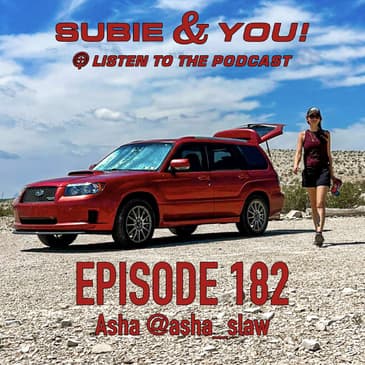
Asha joins us from her solo trip to Alaska from the east coast and shares her solo car camping and road trip experiences and safety tips, as well as some stories along the way.
Links from the show, links to sponsors and discount partners, and ways to support the podcast:
Asha Slaw
https://www.instagram.com/asha_slaw/
Asha’s YouTube Channel
https://www.youtube.com/@ashaslaw
Asha’s Solo Car Camping and Road Trip Safety Tips
https://www.youtube.com/watch?v=zn1Nn-qK0rg
- - - - - - - - - - - - - - - - - - - - - - - - - - -
Subie & YOU! Podcast Website!!
https://subieandyoupodcast.com/
Rep your favorite podcast with some Subie & YOU! Podcast gear!!
Also on the website you will find all the episodes, reviews from Apple Podcast, the About page, and a place to purchase car decals to show your love for the podcast by adding a decal, which we know adds 5 HP to your Subaru!!
- - - - - - - - - - - - - - - - - - - - - - - - - - -
Sponsors of the Podcast:
Subaru Gear
Use code subieandyou24 to get 20% off your purchase!
Get FREE shipping for orders over $50 after 20% discount!
Website:
Accentrek Designs
Instagram:
https://www.instagram.com/accentrek.designs/
Website:
https://www.accentrekdesigns.com/
Mele Design Firm
Use code Subie+You on select Rally Spec products and Subaru products to get 5% off your purchase!
Website:
New Crosstrek Battery Mount:
https://meledesignfirm.com/products/subaru-crosstrek-group-35-mount
- - - - - - - - - - - - - - - - - - - - - - - - - - -
Other Brands Offering Discounts
Orbis Overlanding
10% discount off Orbis Overlanding and partnering car products
(excludes apparel)
Discount code: subieandyou
Website:
Spider No Drill Roof Rack
Use code subieandyou to get 10% off a rack for your Subie!!
https://www.spiderroofrack.com/
YescomUSA
10% off awning with LED light bar.
Discount code: SUBIE&YOU10
Website:
[00:00:11] Hi, this is Asha tuning in from a solo road trip to Alaska and you can find me both on YouTube and Instagram at Asha Slaw. You're listening to episode 182 of the Subie and YOU podcast. Okay, so my guest today is not
[00:00:27] technically an international guest in the sense of she wasn't recording from an international location. However, she is from Poland originally and now she's living in the US. So she's kind of an international guest, I guess you could say. Welcome to episode
[00:00:50] 182 of the Subie and YOU podcast. Thank you for tuning in. Thank you for checking out this next episode and listening to Asha's story here in just a bit. It was really cool to have her on and hear her talk about her journeys because
[00:01:08] she's traveling across the US to Alaska from the East Coast and so we'll get into that but it's just like she has an older Subaru, which is really cool. It's a really nice Subaru and
[00:01:25] she outfitted it for car camping. So we'll hear all about that here in a little bit. But it was just it was a really good conversation and I think you're gonna really enjoy it. The Subie and YOU podcast is brought to you by Eccentric Designs.
[00:01:39] For those of you who don't know, Eccentric Designs is a small community-driven business that offers custom fit vinyl overlays for most Subaru models. This includes various designs for the rear reflectors, taillights and side taillights. I also offer fun decal designs like the popular fender stripes and stickers.
[00:01:56] To find designs for your Subie head on over to eccentricdesigns.com. There's always more projects in the works so be sure to follow at eccentric.designs on Instagram. And as always, thank you so much Eccentric Designs for sponsoring the Subie and YOU podcast.
[00:02:12] If you have not been to her site before go check out eccentricdesigns.com and check her out on Instagram and see what she has to offer for your Subaru. That is where I started.
[00:02:24] I started with decals and then I moved on up to other things and decals are a really great way to help personalize your Subaru. So go check it out.
[00:02:34] I don't know about where you are, but we've had a lot of rain out here and I'm just about tired of it. It's rained quite a bit lately and ever since we had... after the hurricane that came through here,
[00:02:48] it's been raining a lot since then and it's just... I'm over it. I want to go for a walk outside. I want to go for a run outside. I mean though all the rain makes for good mud and
[00:03:01] if you know me by listening to the podcast or if you follow Pearl the Cross Trek, you know that I like mud. But I'm not even interested in hitting some mud right now.
[00:03:12] I just want it to be sunny and not raining. So I hope you have good weather where you are. This episode is also brought to you by SubaruGear.com and SubaruGear.com is celebrating plastic free month in July.
[00:03:29] They are recommending sustainable swaps such as using refillable water bottles versus plastic bottles, using the bamboo utensil sets over plastic ones and their tote bags versus plastic bags for shopping. Subaru Gear also just launched some men's and ladies Chaco Wilderness sandals
[00:03:50] that can be found in the headwear and accessories at SubaruGear.com. Be sure to use the code SUBINU24 for 20% off your purchase of any of the sustainable items or any other items found on the site.
[00:04:05] Remember that if your total purchase is over $50 after the discount you automatically get free shipping. Thank you so much SubaruGear.com for sponsoring the Subinu podcast and bringing this great offer to the listeners.
[00:04:19] All right, this weekend coming up is going to be a big weekend. You have two really big events. You have Subaru Flat Fest in Madison, Wisconsin this Saturday, August 3rd, and you have Subifest California August 4th in California.
[00:04:34] So whichever one you are going to I hope you have a great time. I hope it's a good event. Hope you get to meet some new people catch up with some old friends and hopefully see some celebrities out there for some Subaru
[00:04:48] celebrities. So have a good time and stay cool and drink lots of water because I know it's going to be hot. Just be sure and stay hydrated. That's very very important. But again, most of all have a good time. Enjoy yourself and
[00:05:05] have fun with your friends and checking out all the vendors and of course all the epic Subarus out there. And of course this episode is brought to you by Mele Design Firm where they believe that quality parts should look great while adding
[00:05:18] functionality to your build. At Meledesignfirm.com not only will you find their battery mount systems, engine bay caps, and other Mele products, you also find products from other great brands available on the site. Mele Design Firm offers products from Anderson Design
[00:05:37] Fabrication, Anti-Gravity Battery, iWire wiring solutions, as well as products from Nameless Performance, Off-the-Line Performance, and of course Primitive Racing. So head over to Meledesignfirm.com for many of your aftermarket needs. Thank you so much Mele Design Firm for sponsoring the Subie and You podcast.
[00:05:58] All right, and now it is time to get into this conversation with Asha. I hope you enjoy this conversation and maybe learn a few things about solo travel and solo camping. She also has a YouTube video about safety.
[00:06:14] So if you go to the app on Apple Podcasts or Spotify and you scroll, there will be a link there for the video that she created for safety when solo traveling and solo camping. There's also a link to her YouTube channel.
[00:06:32] So go check that out as well. And now we will get into this conversation with Asha. Here we go. Welcome to the podcast from your solo trip to Alaska. Thank you.
[00:06:57] You're welcome. I've been excited to have you on because I know that you're doing a lot of traveling in your Forester and sleeping in your Forester, and I'm just excited to hear about it. Thank you so much. I'm really excited to be part of your podcast. You're welcome.
[00:07:15] So if I think you said you've listened to some of the more recent episodes, and if that's the case, then you know one of the big questions that I always ask, and that is whether people prefer waffles or pancakes. Well, for me, crepes. I'm European.
[00:07:38] You probably didn't expect this answer, but for me, it will be always a good crepe with cottage cheese, sweet cottage cheese. Gotcha. Yeah. Now, do you eat pancakes or waffles at all or not? Oh, I would eat a waffle, but I wouldn't eat a pancake for some reason.
[00:07:56] It's just too thick and it's too thick for me, you know? Okay. Okay. Yeah, that's a good answer. It's a different answer for sure, but that's a good one. I know. Okay. Yeah. Yeah.
[00:08:08] I guess let's kind of start at you deciding to convert your Subaru Forester into like a long-term travel camping vehicle. Where did that whole decision come from to do that? Why did you do that?
[00:08:26] Well, I always wanted, I was always dreaming about going for a really long road trip across the US. Back when I was living in Poland, that was always my dream. And at some point, I just thought, why not? It's just we're only getting older.
[00:08:43] So I should just try and do it. And I didn't have that car before the idea came into my mind. I actually researched the car and I really wanted to have an older Subaru with manual transmission.
[00:09:02] And it appeared that this kind of Forester, this model is actually the best one. So that's why I tried to find it because it's actually pretty difficult to find them and find them in good condition. Because apparently there were only 240 of those ever producing 2008 for North America.
[00:09:24] So this particular model of the car is called a Unicorn. So yeah. Wow. How long did it take you to find it? I would say I was pretty lucky. I would say it was more or less three to four months.
[00:09:39] But I was pretty picky because I didn't want to, I really wanted to have a clean one. And for a clean one, you have basically options like you have three or four states that you
[00:09:52] can try to fish out that car from, like I would say Florida, New Mexico, Portland, Oregon, et cetera. So I really wanted to have a clean one and it took me three to four months, which is super
[00:10:07] fast because based on the forums, I can say that people are trying to buy one of those Foresters for years. And sometimes it's really difficult for them to find it. Yeah. It's a really nice color too. I mean, it's just an overall great looking Forester.
[00:10:24] And yeah, you're very fortunate that you found it that quickly. I mean, I'm sure you must have been super excited when you found it and knew that you're like, okay, I can actually get this now. I was extremely excited.
[00:10:38] The thing is that I live on the East Coast and the car was in Portland, Oregon. So I was really determined to get it. So I just bought it and the previous owner who actually took such a good care of it,
[00:10:50] just stored it for me for a month or two until I was ready to fly there and actually drove back home to fulfill my dream of crossing the US by myself. Yeah. There you go.
[00:11:05] That was your dream to drive across the US and you did it for the first time, I guess, in the car that you found that you were looking for.
[00:11:13] And what a great way to kind of get the overall feel of it and break it in is just take it on a long trip. Yeah. I mean, it was also pretty risky, I must say, because I didn't know the car and I trusted
[00:11:25] the previous owner, but you never know. You simply cannot even recognize the sounds of the car. So it was a little bit stressful, but it all went great. Actually, previous owner, again, he was great and he made sure during the pre-purchase
[00:11:43] inspection that the car runs great because he knew I will be driving it across the country. So it's great. Yeah. How many miles did it have on it when you bought it? I think it was 116,000. Okay. Not too bad.
[00:11:59] Yeah, no, it wasn't too bad, but the condition is amazing. There's basically no rust at all. And whenever I service it, they always want to buy it. Yeah. I mean, if it's that much of a unicorn in a gym, then I'm sure people are like, how
[00:12:15] much should you sell this car for? No, it's not going to happen. I wouldn't. Yeah. Now, were there other cars in consideration for doing this trip or was it because you said you were doing research and you said that you found this one was the best one?
[00:12:31] But so I'm guessing maybe there were some other ones you were looking into also? I mean, I knew I need a larger model. I knew I want an old Subaru because I own two more Subarus, which are pretty old. Okay. So that is my third. Nice. Subaru.
[00:12:51] And I knew the other two that I have, they're simply too small to do a road trip. So I knew it has to be a Forester. I was also considering an Outback and I cannot remember the generation, but there was one
[00:13:08] model of an Outback, which was also a manual and it was perfect for a road trip. But I talked to my mechanic and he said it's also impossible to get them because people who have them, they don't want to sell it because it's simply too good.
[00:13:26] So in the end, I just decided to go with the Forester because I simply love the way it looks. Yeah. So what are your other two Subaru's? So first one is an old Subaru Impreza GT from 96. Okay. And that's my first car ever. Nice. I still own it.
[00:13:48] It's in Poland. And the second one is Subaru Legacy RS, I think it's from 97 and that car used to belong to my dad and I inherited it. Very nice. Very nice. So I guess you're kind of a Subaru family. Would that be safe to say? Yeah.
[00:14:07] We only drive Subarus and yeah, I love them. And my little Subaru Impreza is the best car ever. It's literally, I will never sell it because it's a really reliable car. And I knew that an older Subaru will be a good car for a road trip, especially manual,
[00:14:27] if I wanted to get a manual car. How many miles do each of those have on them? Or I guess maybe they're kilometers? Kilometers. Yeah. That's why I was like, oh my God, I will have to do the math now.
[00:14:41] So you can just tell us kilometers and people listening can do the math themselves. Okay. So I think the Impreza is around 350,000 kilometers and the Legacy is way above 400. Wow. And they run great. And they're just great, you know? And they're both manual? Both manual, both turbos. Nice.
[00:15:07] Yeah. Really fast cars, really reliable cars. I would say that they are both in Poland. So whenever I'm there, I drive them and they are faster than most of the cars on the road. So... Very nice. Yeah. Yeah. It's a pleasure to drive them.
[00:15:25] It's a pure pleasure, literally. So I have a Crosstrek. I have a 2021 Crosstrek and it's not fast by any means, but it is a manual and I love that. Oh, nice. Yes. I knew that Crosstreks came as a manual for the second generation.
[00:15:43] Unfortunately, they stopped that with the third generation. But I was not going to buy one unless I could get a manual because I only wanted a manual because I hadn't driven one in years and I missed it.
[00:15:56] And I'm like, I'm going to get a manual or I'm not going to get one. Good. Good. Good for you because I only believe in manual cars. Yeah. I mean, like I said, mine is slow, but I just, I enjoy driving it every day.
[00:16:11] And like, you know, when you're driving a manual and you drive it every day, it's automatic in the sense of you just automatically drive it. You know, you don't really think about it when you're driving it.
[00:16:23] But every once in a while it hits me, I'm like, man, I'm driving a manual. This is so cool because it's different, you know? So many cars are an automatic, you can just hop in it and go. But with a manual, it's just such a different experience.
[00:16:36] It is. You just feel the car, you know? That's the whole thing. You're like a part of the car. I don't know how to explain it, but it's just... Yeah. Manual owners understand it. Exactly. Though it's a pain in the US when there are too many stop signs.
[00:16:53] It's just, it's a pain sometimes, but you know. Yeah. It's, yeah, I mean, I don't, thankfully, I don't drive through too much traffic and I only go into the office two days a week and there's not that much traffic. I'm usually on the highway most of the time.
[00:17:07] So there are, there have been times like if I'm going somewhere on the weekend and there's a lot of traffic, it's bothersome. But other than that, like I wouldn't get rid of it because of, you know, I mean,
[00:17:19] I know somebody that had a manual just recently, not a Subaru, but they had a manual and they were in stop, you know, stop and go traffic every single day. And they got rid of the manual because they're like, I can't take it anymore. Yeah.
[00:17:31] I can get it probably like, you know, in a big city like New York City or something like that. It would be a really difficult thing to drive on a daily basis. Yeah. Yeah. So you found this, the Forester, you're really happy that you're able to find it
[00:17:46] because you got what you wanted. And then now you drive it all the way back to the East coast. So what kind of preparations did you make to start converting it into, you know, the vehicle that you wanted it to be,
[00:18:02] to be able to sleep in, to have all the gear you wanted? And then, you know, like what was, would you have to start doing? And then how long did it take before you were ready to take off?
[00:18:13] So I started the research basically when I knew that I have the car. So when the car was waiting for me in Portland, Oregon, I started doing the research and I went to the YouTube university to figure out how to do it.
[00:18:26] And what are the best ways to just car camp? And when I brought the car here, it basically took me, it was still winter. So it took me, I would say altogether maybe a month to convert it. Not bad. No, no, no at all.
[00:18:43] The thing is that I didn't have any tools, so it was pretty challenging. So in the end, first of all, I removed all the back seats so I could just build the platform. I didn't need those seats.
[00:18:59] I put an insulation because the car became so freaking loud when I was driving it. I could feel, I could hear the fuel splashing in the tank and I'm like, this is just too much. Because the seats were the insulation.
[00:19:15] So I'm like, okay, now I have to do the proper research. So I actually found a really good insulation, which is non-toxic. I wrapped up all the cables so they don't break if something happens or if the water spills.
[00:19:28] And then I did my design and I designed it according to what I thought will be good for me. And then I rented a few tools at Home Depot. I bought two big sheets of plywood and cut everything in my backyard.
[00:19:48] And then I went to New York City to finish my project because I was not able to do all the little parts in my backyard. So I actually did a fast course in woodworking to be able to work in a professional woodshop in New York City.
[00:20:11] And I did the course, I got certified as a, well, maybe not professional woodworker, but to be able to do it. And I went there and actually I used all the professional tools and machines to finish my project. And then I put everything into the car.
[00:20:29] That is really cool. That's like such a great idea to do that, you know, to have, I mean, you've got such a great resource there to help you get it finished up. Yeah. I mean, you know, they didn't really help me. It was more I needed...
[00:20:43] Oh yeah, yeah. There was just, there is this shop where you pay by hour and you just get a table and you can use all their machines. The thing is that they don't want you to hurt yourself. So you have to actually know how to use them, etc.
[00:20:59] But it was so much fun, so much fun. It was an incredible experience. But that's now you've got a great skill too. Yeah, yeah, exactly. Exactly. Now, did you do all of the work yourself? Yes. That's cool. All of it. All of it.
[00:21:15] But you know, I'm also Eastern European, so I grew up in the forest and on the farm. So more or less I knew how to use drills and everything else. So it was more about getting, you know, used to using big machines and just
[00:21:31] putting that knowledge into action. Yeah, that's good. So you got it all ready and everything. Then I guess you're like, okay, I'm ready to head out. So like, I don't know, I guess I'm not even sure like where to start with that.
[00:21:48] But like, I guess kind of take us through your thought process and like where you... So was your goal just to drive from the East coast to Alaska? Like that was the end goal. And then I guess you're going to head back at some point.
[00:22:04] Yeah, so we are talking right now about a year ago, more than a year ago. So last spring, I would say I researched everything. I bought stuff, you know, car camping things that I thought I will need, like mattress, et cetera.
[00:22:19] And at some point I decided that I just want to head out. And the plan was actually to go all around the US. I'm sorry, all around North America with a midpoint Alaska. That was my original plan. And that's how I started.
[00:22:33] I actually started on the East coast and went all the way down south to Texas also. Yes, I saw that post. Yeah. So I ended up camping in Big Bend National Park for a few days.
[00:22:50] And then I went all the way up to Glacier National Park in Montana. And the plan was actually to go all the way up north to Alaska. But unfortunately, some tragic events in my life happened and I had to park my car for
[00:23:08] almost two months in Salt Lake City and fly back home to Poland. So Alaska never happened last year. And then I resumed my trip and I actually went to California and all over the US.
[00:23:23] So I ended up driving all around the US last year and in the end drove back to the East coast, which was my third time across the country. Yeah. And you put in what? Almost 19,000 miles that whole year in 2023?
[00:23:40] No, that was just the road trip, which was four months altogether. Oh, okay. 19,000 just in that road trip. Yeah. Wow. Any issues with the car at all that whole time? Well, I'm always worried about answering these questions not to jinx it.
[00:23:58] But no, there were no issues at all with the car. Also, the thing is that this car really likes taking oil. So I actually have to service it every 3,000 miles and change the oil every 3,000 miles.
[00:24:12] So I was also making sure along the way that the car is properly serviced and that nothing will break along the way. Of course, you can never predict it, but I'm taking a pretty good care of this car. So yeah, but nothing happened.
[00:24:28] And I was shocked actually because, you know... That's good. It's an older car. It's a car from 2008. Yeah. So when you were taking this road trip, what was the longest distance you drove all at once? I would say that both times when I was... Oh, no.
[00:24:49] Every time I was crossing the country, the... I don't want to say boring because I don't want to get people from Midwest to be mad at me. But usually the part from the East Coast to Denver or Oklahoma is the part which
[00:25:11] isn't the most entertaining for a driver. So I would say that the longest, I would say it was probably 12 hours because whenever I'm coming back or driving all the way west, I just power through Midwest. Yeah. I try to drive as fast as possible.
[00:25:28] And it's also more difficult because there are not many car camping spots or camping spots or BLMs along the way. So you just need to get a hotel, etc. So it's money consuming. Just what you have to do. Yeah.
[00:25:42] So answering your question, I would say that probably there were a few times I drove 10 to 12 hours just to get home or just to go all the way west. Yeah. So you were going different places and I saw, like I said, I mentioned earlier your post about Texas.
[00:26:01] So what was your experience like in Texas? Because I'm from Texas. I'm a native Texan and lived here my whole life. You're a lucky man. I just happened to see that one particular one. I don't know why I stopped on it.
[00:26:18] Maybe I was just supposed to because I'm from Texas and you stopped there. But you had very good things to say about Texas. And I really liked that. Yes, because there is this, I mean, I was born and raised in Europe and there is this
[00:26:33] thing about Texas when you watch TV, even though I don't watch TV much. But there is this thing that people are afraid of Texas. And it's like arms or guns, like people are like big pickup trucks, etc., etc. And you're like, Texas is a little bit scary.
[00:26:52] It's like for some reason there is this feeling that you're like, oh my God, Texas will be so scary. You know, it's like everyone will just like be not nice and there will be those huge trucks all around me. And Texas was lovely. It was amazing.
[00:27:10] I also thought Texas is just like, you know, like maybe not a desert, but it's like more less versatile than it actually is. And Texas has it all. It's like you guys have everything. Yeah, it's a big state. Texas has like lakes, forests, Big Bend National Park.
[00:27:30] You guys have everything there and people are so nice. So incredibly nice. I would like to think so. You know, what's funny is I've lived here my whole life and I've never been to Big Bend National Park. Oh, you should go. I want to go.
[00:27:43] It's just from where I am, it's probably I think like over a nine hour drive or something. And it's just I would have to take a lot of time off work and go down there and really enjoy it. But that's true.
[00:27:56] It's really far away from any like it's so far away, but it's worth it. It's worth it. It's beautiful. It's stunning. Yeah. Did you happen to go through? Oh, what was it? Palo Duro Canyon. It's like on the way to Amarillo. I don't know which way you went.
[00:28:16] That's a good question. I am bad with names. I went all the way from Louisiana across Texas through Fredericksburg. Then went all the way down, spent a little bit, I would say probably four or five days in Big Bend. Then I went to Marfa, which is fascinating.
[00:28:37] It's a little town, quirky town, artsy town in the middle of nowhere. It's like we're surrounded by desert. It was really nice. And then I went all the way up to New Mexico. Okay. Yeah. So Palo Duro Canyon, I had never, again, living in Texas my whole life.
[00:28:56] I had never heard of it. And a few summers ago, me and my kids went out to Colorado and my girlfriend was telling me about Palo Duro Canyon. And so when we came back home from Colorado to Texas, we went through there and it was beautiful.
[00:29:11] They call it like the Grand Canyon of Texas or something. It's really, really pretty. Then I think I didn't drive through Palo Alto. Yeah, you may have to check it out. Okay, I will. I will. Next time I'm in Texas. Next time. Yeah.
[00:29:28] So how was it sleeping in the Forester with all the trips that you made? I mean, was it like, did it work out as well as you had hoped it would with the way you had it set up?
[00:29:42] And then like, as far as all of your gear and, I guess, cookware and stuff, did you have everything you needed on this trip? So I did a really good research.
[00:29:56] And I am still using right now, I'm on this solar road trip to Alaska, which is also pretty long. And I still use the gear that I bought last year. And I just did a really good research and my whole approach was don't buy too much.
[00:30:11] You can always buy along the way whatever you need because REI is everywhere. So basically that was my approach. So I bought the basics and maybe I think the only thing that I needed along the way
[00:30:24] was I realized I need was a Garmin Enrich Mini, which is a little satellite device just in case. And that's it. And my car is extreme, like I pack super light so I don't have anything in my car that I actually don't need. It works. It works great.
[00:30:43] So you said there were times that you would have to like stop in a hotel, you know, so what did you do about like showers and washing clothes and stuff like that? You know, I mean, because you're gone for a really long time.
[00:30:56] And then I guess going to the restroom, you know, these are things that it's like that I think about, like, you know, if you're on a really long road trip, do you stop at places to take care of things or, you know, how does that work out?
[00:31:09] Well, it depends where you are, because I would say each it depends where you're staying, of course, because when you're overlanding or sleeping in like backcountry camping, it's different and you go, you have to bring everything with you and you just have those long stretches
[00:31:28] of no shower, which is actually not that bad when you think about it. When you have a few days of not showering, then you shower and it feels amazing. And this is like the best feeling ever. You really appreciate it.
[00:31:42] Oh, my God, you appreciate everything after being like on the road for a really long time. You appreciate every single meal in a restaurant. You appreciate having water like on top because you just carry water and you save every little,
[00:31:58] you know, little droplet just because you don't you're camping in on a desert and you don't know when you will have water again. So you're just like minimalizing the usage of water. And then you go to the restroom, you're like, oh, my God, it's running water. It's amazing.
[00:32:13] So that's why that's one of the reasons why I car camp and do what I do, just because I want to feel those being grateful again for those little things that we take for granted. Yeah, no, that's really good. Yeah, but you know, it's everything is doable.
[00:32:29] It takes sometimes time to plan. I do stay in hotels sometimes when I need a day off, because sometimes it's just really, really difficult when you drive forever or there is nothing else. And I don't feel safe while camping something somewhere or something like that.
[00:32:50] Yes, I have a rule that it's better to pay for a hotel room for a night than to be stressed and not know where to sleep. Of course. Yeah. But, you know, it's it's it's it's OK not to shower for a few days.
[00:33:05] I don't know what to tell you. You know, yeah, no, it's good. When I'm in the apartment, you know, at home, I shower every single day. But it's OK. You're alone. You're solo like nobody can actually let nobody curse if you're wearing a cap or not, you know?
[00:33:21] Yeah. Well, being a solo traveler and especially let me see that over again, being a solo traveler and especially being, you know, a woman, what sort of safety precautions do you take? There are many.
[00:33:34] And I actually recorded a whole video on and posted it on my YouTube regarding safety tips for solo travelers, not only women, because I think everyone should know how to stay safe. And there are at least 15 of them that I could. Wow, that's good. Elaborate on right now.
[00:33:59] But I would say that my rule number one is always listen to your gut. And it works for me. It's like I have a I believe that we we are able to feel. A danger or feel that the situation in which you are in is not right.
[00:34:21] And my rule number one is whenever my gut tells me that something's not right, I just immediately leave no matter if it's in the middle of the night or, you know, at the gas station, which feels a little bit creepy.
[00:34:35] So I would say that this is rule number one. And I always follow my gut. That's good. That's good. Yeah. What else? Well, it's, you know, there's there are rules that it's okay to lie sometimes.
[00:34:48] I don't lie in real life, but sometimes on the way you have to lie to stay safe. And of course, you don't overshare along the way because you never know who you're talking to. You know, just some safety. Always be like pretend that no, when you are going,
[00:35:08] I think that this is also really important how people perceive us. And if you know that you're in a place where people can, I don't know, just stare at you or something like that,
[00:35:21] just pretend that you're nowhere going and it will be less likely that they will think that you're not from there. I have also, I always carry on me a really black and a really big oversized hoodie, which is black.
[00:35:40] And this is something that I wear whenever I pump my car in remote areas. I sometimes often, I often also drive in it just with a hood up and I cover my hair because I simply don't want to look too attractive.
[00:35:57] And don't to, you know, just you never know. So there are many I would, I literally can elaborate about it for an hour. Yeah. If you want to send me the link to that YouTube video,
[00:36:09] I'll put it in with the description and everything so that if anybody wants to watch it, they can. That'd be good. Okay. I will definitely send it to you because yeah, it's just, it's good to know, you know,
[00:36:22] but also I think that it's good not to get too paranoid about it. It's more about being aware of yourself around things, but fear has big eyes and I think that you should balance it. It's good to go for an adventure.
[00:36:36] Just know how to keep yourself safe because you are the only person that can keep you safe on a solo road trip, you know? Yeah. Yeah. So you said that, and you can answer this however you want to, but like you said that it was always
[00:36:50] your dream to drive across the US when you were living in Poland. So when did you come over to the US? I would say nine or 10 years ago. Okay. So I've been here for a while, but you know, I grew up in Poland and we always watched
[00:37:07] American movies and they were always road tripping and they were always somewhere in the desert, in the nice car, et cetera. So it was actually always my dream because nature here is on a completely different level than in Europe. And yeah, it was...
[00:37:25] I'm happy I fulfilled that dream actually already four times. So... Yeah, that's really cool. I mean, there's people here that have lived here their whole lives that don't ever go all the way across country, you know? So that's pretty amazing.
[00:37:39] Yeah. You need to have a reason to do it or just a dream to fulfill. Yeah. It's a pretty long drive though. When you do it once, the map shrinks. And then the second time you do it, you're like, it's easy.
[00:37:54] It's not that scary at all, you know? Yeah. I mean, so I live in Houston and my girlfriend lives in Dallas, which is about a four and a half hour drive. And I tell people that they're like, oh, that's so far.
[00:38:05] But I've driven it so many times that driving up there and driving home, it's like, it's nothing now. It doesn't feel like it takes that long to get up there at all.
[00:38:16] And I use that road time to listen to other podcasts or listen to an audiobook or something. So, you know, that helps pass the time. But yeah, that totally makes sense. That if you do something the first time, you're not exactly sure where you're going, you're
[00:38:32] anxious to get there. I think the anxious feeling of just wanting to get there is kind of what makes it take a long time. And then, you know, you do it again and then it's not that bad.
[00:38:43] I mean, my daughter was going to school in Arkansas and that's like an eight and a half hour drive. And that drive, because I didn't go up there as often, it was still long, but still not as bad as it was, you know, the first few times. Yeah.
[00:38:57] It's also, you know, I think it's also different for people living in the US versus Europeans. I have European perspective and for us driving even two hours takes forever because we have smaller roads, more congested.
[00:39:12] And for some reason here in the US, if it's two hours, four hours, six hours, it's just it's not that bad, you know, you have a comfortable car and a really nice road ahead of you and you just do some soul searching along the way.
[00:39:25] And I think it's, yeah, it's different in Europe for sure. So open roads in the US are better. Oh, that's good. Yeah. Well, so like being that you've done this trip so many times and, you know, of course
[00:39:39] being solo and camping and not showering for a few days, like what are some of the things that you've learned about yourself on these trips? That I like being alone. One thing.
[00:39:54] No, actually it's, I really like doing it by myself and I do a proper soul searching while driving and I think the best way I'll drive. So actually do those long road trips are kind of serve me as a therapy, I would say.
[00:40:14] And what did I find about this? I think in general, I realized that what we were talking about earlier, that going minimalistic for a month, two or three is really good for you because we as Western society got used to things and we surround ourselves with items.
[00:40:36] And yeah, in like in my normal life when I don't road trip, I have nice dresses and, you know, it's just I live a normal life. But I really enjoy just taking four or five sets of clothes and having a little camping
[00:40:53] stove and just enjoying my life that way, the simple way. And I think that that's realization that we don't actually need that much and we don't need that shower every single day was a big realization for me, which actually made me
[00:41:12] go all the way to Alaska this year. That's good. Yeah. Yeah. There's a couple that I know that, and if you know there are people that do this, but it's a couple that I connected with on Instagram several years ago and they were living in a
[00:41:25] house, but their dream was to build a van and live full time in the van. And they got rid of like so much stuff. And then they have so little now in the van and they got used to it and they really, really enjoy it.
[00:41:41] Yeah, I totally understand it. Van is a little bit more fancy than a car, I would say. Sometimes when it's the weather is really bad or it's raining or something like that.
[00:41:52] I'm like, I wish I was in a van, you know, because it was like, you have much more space. But I totally get it. And I totally understand people who actually move to vans because you can be on the road
[00:42:05] all the time and you don't need that many items. Yeah. And they are both park rangers. And so they work like six months out of the year as park rangers. And then the other six months, they just enjoy traveling around and going wherever they want to go.
[00:42:21] That's amazing. Yeah, awesome. Good for them. Yeah, because they're older, their kids are older, you know, they're, I guess, somewhat retired and that's, you know, they work so that they can have, you know, the financial means to do the things they want to do.
[00:42:34] But I mean, that's pretty amazing that they can do that. It's amazing. Yeah, I feel like this van life is becoming a thing. It's more and more popular, especially with the possibilities on the West, because BLM
[00:42:49] and all those places where you can actually, you know, just park for 14 days and enjoy beautiful nature. It's a way to live. Yeah. So you've been to a lot of places throughout the US, but like, and I know that I'm sure
[00:43:09] you've seen like a lot of really beautiful spots. Is there one that like just stood out to you? Or are there too many to like pick one? Because I've asked this question to other people and they're like, I don't know, there's so many beautiful spots.
[00:43:23] I just, it would be impossible to pick one spot. For me, I totally agree. US has so many beautiful spots, but I would say that Teton's, Grand Teton, I think this is the Grand Teton National Park is the place I would go back. Where is that? Wyoming. Okay.
[00:43:49] I've never been to Wyoming. It's right next to Yellowstone. So you have Yellowstone and then an hour away, the Teton's and Jackson Hole, which is a pretty popular spot. It's mind blowing. I would say that Yellowstone is a little bit overrated.
[00:44:10] And so if anyone is planning to go to Wyoming, just go to Yellowstone for a day and then go to see the Teton's for a longer time. Did you go through the Grand Canyon or by the Grand Canyon when you went? Oh yeah, I even hiked Grand Canyon.
[00:44:31] I hiked all the way down to Grand Canyon and spent a night there. And then I hiked all the way up. It was really hot and chilly, but it was beautiful. Yeah, we went out there.
[00:44:41] I took my kids out to Arizona because I had some friends that lived in Flagstaff and we stayed there for a week and we went to the Grand Canyon one of the days just to go see it. And it's just, it's amazing.
[00:44:52] Like you can't, that's again, one of those things where it's like the pictures don't do it justice, videos don't do it justice. Like you have to see it in person and it's just like amazing.
[00:45:03] It's so like you, there's parts of it that are so far away from you. It looks like a mural from a movie. Like it doesn't look real. It looks like somebody just painted it across the sky. I agree. I agree.
[00:45:14] And when you think how old this thing is, you're like, we are so little, like, oh yeah, we almost don't matter. You know, our lives are like nothing compared to the age of Grand Canyon or all those mountains on the west side of the continent. Yeah.
[00:45:33] Mountains are my favorite thing. After going to Colorado for the first time, I was just like, mountains are it for me. Like if I could move to Colorado and live there, that's what I would do.
[00:45:43] I've been there a few times, but I would like to at least have a place there maybe, you know, cause I mean, it's not going to just be up to me cause I'm going to, you know, be with somebody.
[00:45:54] So it's, but I would love to go back and visit at least visit many times. Yeah, you definitely should. Colorado is beautiful. It's beautiful. Mountains are also for me. I'm not a water person. I love staring at mountains. There's something magical about them.
[00:46:14] So where have you not been in the US that you want to go or that you are planning to go to? So I always wanted to go to Alaska and I already fulfilled this dream a few days ago, entering Alaska. Very nice.
[00:46:31] I would say I still didn't have a chance to explore it. So I would say that now my dream is almost fulfilled. It will get fulfilled in the next few days probably. So when you've, you've gotten there now, but like, was it what you were expecting or was
[00:46:53] any of it disappointing? Or was it like, how has it been so far? So I would say that the challenging part was getting there, which is Alaska highway, which is a pretty remote highway.
[00:47:07] And this was something that I was really looking forward to, but also was a little bit anxious about because it is really remote. There are not many even gas stations along the way. And if your car breaks, you are, you don't have many, many options.
[00:47:25] So this is something that I was worried about. And actually Alaska highway surprised me and Canada, like the way to Alaska surprised me. Canada is beautiful and places along the way were mind-blowingly beautiful. All those colors and, you know, glacier lakes, glacier rivers.
[00:47:46] It's just, it's like from a movie. And for now, I would say that Alaska is probably the most interesting part is in the South. And I haven't made it there yet. So for now, I'm just soaking in just the general impressions or surroundings of Alaska.
[00:48:08] And soon I'm planning to go all the way down and explore. How long do you plan to be there? More or less for a month. Okay. That'll give you some time. Yeah. Now, do you keep, do you have extra gas cans with you?
[00:48:26] Like the spare gas cans, you know, that can give you a little extra bit? They say that you should have them, especially for the Alaska highway. But to be honest, I really didn't want to get a roof rack. First of all, it's really expensive.
[00:48:42] And second of all, it draws too much attention to the car. It's, it just screams I'm traveling. So I decided to go without the extra jerry cans. And on the Alaska highway, it was actually, I made, I created a habit of pumping every
[00:49:04] time I had a, I saw a gas station. So right now I don't have anything like that. I just have to keep an eye on my, the level of my gas. Yeah, that's good.
[00:49:14] It's nice to, like you said, to just pump whenever you can, because, and I guess just kind of keep it filled up. Right? Yeah. I think the worst problem is actually tires, because the roads there are horrible. It's permafrost. So basically everything is, it's one big pothole.
[00:49:36] So this is something that I'm more worried about, getting a flat tire in the middle of nowhere. And they also, they also say online, when you research it, they say you should get, you should have a spare on you and additionally a full spare, a full size tire.
[00:49:53] But again, I didn't want to get a roof rack. So I got, I got slime. I think that's how it's called like a little slimy thing that when something happens to your tire, just shoot it into your tire and apparently it works. Yeah.
[00:50:09] I don't know if it works or not. I want to believe that it works and it will work whenever, if I will need it. But hopefully I won't need it. I just, but driving there, it's like the potholes are crazy.
[00:50:20] I saw so many cars on the side, on sides of the road, just like with, without tires. So we'll see. Yeah. Well, I mean, you know, it's worked out so far. Yeah. So we're yeah.
[00:50:34] I mean, it's like you've been to so many places and it's like kind of hard to know, like what questions to ask you? I don't have any suggestions. How many, about how many miles do you have on the Forester now?
[00:50:52] Cause you said it was about 116 when you bought it. I think it's around 141. Okay. Something like that. Yeah. It's not. More or less. Yeah. No, no, no, no, no. It sounds worse in kilometers because it's almost twice as much.
[00:51:11] You said you did a lot of research on, you know, how to set up your, your camping gear or set up, you know, the sleeping and arrangement and all your gear and everything online.
[00:51:23] Did you connect with anybody in the Subaru community that, that you like maybe saw was traveling and ask them questions or was it just all through YouTube and other researching? I didn't connect with anyone.
[00:51:36] I mean, I connected with people from some of our community with mechanics who I know regarding the car itself. And I just wanted to make sure that the car I'm buying is a legit car, but regarding
[00:51:53] setting up my car for a road trip, I just researched everything and I went again with my guts what I think I will need or not. I actually, there's a really cool, I can't remember his name now, but there is one YouTuber
[00:52:09] who converted his Subaru Outback and he did a great job and I took some inspiration from him. It's, it was, I had to design it in a completely different way also because Outbacks are much longer and his Outback was a new one.
[00:52:27] So I had to adjust everything and I would say that, yeah, I took maybe one or two things from him and then I completely went with my own flow. Now, do you have your, do you have it all set up to where, cause you said you took the
[00:52:42] back seats out. Do you have it set up to where if you wanted to someday, let's say sell it again, that you can put it back to the way it was? Completely. I didn't destroy a car. I didn't drill any hole in a car.
[00:52:58] So I utilized bolts and all the things that were already in a car. So my sleeping platform is actually on the piece which was holding the back seats together. So I completely used every single bolt and hole that was there.
[00:53:17] And I actually can remove my sleeping platform and the whole thing in 10 to 15 minutes. Oh, that's good. Yeah. Cause I also wanted to have that flexibility because my spare wheel is under my sleeping platform.
[00:53:32] So I have to, if something happens, I have to be able to remove it quickly. So yeah, I basically, I would say that to remove everything, it would tell me give 30 minutes to remove everything with, you know, with the insulation, et cetera.
[00:53:49] And then I can put that my back, my back seats and the car looks almost like new. Yeah, that's good. Now I'm guessing you probably haven't connected with too many people on Instagram and then actually met up with them during your travels.
[00:54:03] It's all been a hundred percent solo. It is solo. I meet many Subaru people along the way simply because I service my car in pro Subaru shops. Okay. Because I go to shops which are, which specialize in turbo Subarus, simply because the car
[00:54:23] takes Motul oil and even Subaru dealerships, they don't have it. It's an oil, which is like a French brand and fancy French brand for a fancy car. No, I'm joking. It's, it has to be a specific oil to go into the car.
[00:54:42] So I usually research ahead of time shops, which I will visit along the way. And I stay in touch with the guys. It's like whenever something happens or I hear a weird noise, I just call them and they
[00:54:57] remember me and they usually are able to diagnose my car through the phone, which actually happened a few weeks ago. I had my first problem with my Subaru a few weeks ago in the middle of nowhere in Canada.
[00:55:10] So yeah, guys from Illinois who service my car literally, I don't know, 4,000 miles ago helped me through the phone and diagnosed it through the phone. That's good. That's really good. Yeah. And I'm sure they're like, man, this car is so sweet. We got to take care of her.
[00:55:33] Yeah, exactly. And you know, when they heard I'm going all the way to Alaska, they're like, oh my God, we have to make sure she will get there. You know? Yeah, no, that's nice.
[00:55:41] It's nice to have somebody looking out for you and, you know, taking care of you like that. Yeah. And it's also, you know, it's a pretty specific car. So I don't know with, with, with that thing that was happening recently, which was actually we're a wheel bearing.
[00:55:58] I was really happy that they were able to diagnose it and tell me where to go and that I have to find a person who actually specializes in, who knows how to deal with those kinds of wheel bearings.
[00:56:10] Because apparently this Forester and this Yarrow Forester, their wheel bearings are extremely difficult to replace. And it takes seven hours to replace them. Oh wow. And it did take seven hours to replace them.
[00:56:24] I'm really happy that, you know, to have people who are, who are able to tell me what to do and where to seek help. You said you're going to be in Alaska for probably a month and then you're going to head back out to the East coast again?
[00:56:41] Yes, yes. But first I have to drive down the Alaska highway. Yeah. Again. Yeah. Are you, are you gonna, do you have it mapped out to where you're going to go through somewhere different on the way back that you haven't been to before?
[00:56:56] No, no, actually on the way back, I'm just, I knew I wanted to get to Alaska. I knew what I wanted to see in Alaska and then it's all whatever I feel like. Okay.
[00:57:09] But I find it the most interesting, you know, I wake up and I feel like driving two hours and seeing this mountain instead of going somewhere else. And the thing also with car camping is that you cannot really plan ahead of time.
[00:57:24] You cannot book, if you want to camp on established campgrounds, you cannot really book ahead of time because you never know if your car will make it there or something like that.
[00:57:36] So I find it the most entertaining and adventurous just to listen to your heart and know where's direction, but just go with no plan. Yeah, no, that's good. Because then you can, I mean, I like, I'll drive around sometimes just even here where
[00:57:54] I'm at and not necessarily going anywhere, but just go for a drive. And I'm like, I haven't been down that road before and I want to go see what's down that road. Or if I'm going somewhere like into town or going to somebody's house that I've been to
[00:58:10] before, I'm like, it's because I put in navigation, even though I know how to get there, just because I want to see what navigation says as far as like how long it takes to get there.
[00:58:20] And so, you know, a lot of times it'll say like, it'll show us an alternate route and it'll say like similar destination or similar, you know, like timeframe of when you're going to get that. I forgot exactly what it says.
[00:58:32] And I'm like, well, let me go that way just to see what that direction is. So yeah, that's a good plan to your plan to have no plan. Exactly. That's the best plan.
[00:58:42] Now, when you get back to the East coast, are there plans for other road trips or are you like, okay, I'm good for a while? I think I will be good for this year for sure, because it takes 70 hours one way to get from
[00:59:00] the East coast to Alaska. And I must say that it's, it takes a toll on you. Road trips, my road trips, which are usually last three to four months, they take a toll on me and people may think, oh, okay, she's just car camping.
[00:59:16] It takes so much preparation and it's much more difficult than being actually in the house and living in an apartment because you have to take care of so many things every single day and plan everything.
[00:59:30] Like even, you know, go and do laundry, have food, I don't know, find ice. It sounds like nothing, but it actually is challenging often. So after three or four months, I usually am done. And I just park my car and forget about road tripping.
[00:59:52] I mean, long road tripping for a good few months. Yeah. Now, do you have, you said looking for ice, do you just use a regular cooler that you put ice in or do you have like a refrigerator in your Forester?
[01:00:06] I decided to use a cooler because I do have a source of power, which is actually a really big Jackery, which lasts me, Jackery is like a power station. It's a brand and it usually lasts me for a week. Oh, that's good. Yeah.
[01:00:27] And I charge many things along the way. So, and I also, it's really cool because you can also charge it while driving from the car. So it's amazing, but I simply, I don't know, I just, I researched it properly.
[01:00:44] And for some reason I thought the cooler will be just easier to maintain. I also don't like any buzzing at night. So yeah, so I went with a cooler, but cooler is, it's also, you know, it's so difficult,
[01:00:58] like it's not difficult, but it's always a drag to empty it, et cetera. But it works, you know, it's, it keeps everything cool for a few days. So it's okay. But I have to remember to refill it with ice. Yeah.
[01:01:12] So you mentioned you don't want to sleep with buzzing at night. So what is, how is it sleeping in your car? And do you have any challenges with sleeping? Have you had any like, you know, crazy experiences with trying to sleep and there being loud
[01:01:28] noises or wildlife or anything? Wildlife is always there, especially I had a few times when I think there was a bear, black or grizzly bear walking near my car because I could hear the like weird puffing, et cetera.
[01:01:44] But it's, it's, it's all a part of the experience, I guess. I would say that the worst are chipmunks and other creatures that just run races on your car in the middle of the night and you don't know what it is.
[01:02:00] I love sleeping in my car and I absolutely love sleeping in my car and it may sound weird, but I sleep better in my car than in a hotel or in my own bed. Wow. I absolutely love it.
[01:02:13] Probably because my mattress is more comfortable than my mat for sure. Just bring it into the house, you know, into your house and put it in there and sleep on it. I should, it's just really narrow, but yeah, it's, it's, it's, it's extremely comfortable
[01:02:29] and I really like sleeping in cold temperatures and usually it's cold outside. And I just, it's fresh air. I don't, I really don't know how to explain it, but I sleep the best in my car.
[01:02:43] Now have you been, do you have a fan or anything for when it's not so cold? So I used to have a fan and I actually didn't take it on this road trip because I never used it. And yeah, I, I, I slept in Texas.
[01:03:00] I've been to hot places and I never had a problem with heat and the temperature in the car being too hot during the night. For some reason I was either lucky enough or I just didn't care.
[01:03:16] Cold weather is much more challenging, but it's a matter of layers and sleeping bag. Condensation and sometimes you wake up and you have ice all over your windows, which is pretty cool.
[01:03:30] So it's also a part of the experience, but I don't have a fan and I also sleep with everything, all my windows rolled up simply because for some reason my car is ventilated enough that I can easily sleep in my car with everything closed.
[01:03:50] And also I have to do it for, especially when I'm in a bear country or grizzly bear country where you simply have to lock and seal your car in order to be able to sleep in your car with your food and sun-tanned items inside.
[01:04:05] You don't want to wake up to a grizzly bear staring at you. Do you have covers for your windows too? Like for privacy? I do. I actually made them by myself. Oh nice. YouTube University again. And they are made out of Reflectix and black fabric.
[01:04:27] I basically cut the shapes and used Reflectix, which is like a silver insulation. And then I put black fabric, glued black fabric on one side of those covers so I can actually slip them.
[01:04:47] If I'm sleeping in a really hot environment, I just put the silver side out so the car doesn't get too hot. And when I sleep in a really cold weather, I just put the silver in so the heat stays inside.
[01:05:06] So this is an easy way just to balance the temperature in the car. And how do they affix to the window? Like how do they stay up there? I am able, they're pretty stiff.
[01:05:17] The Reflectix is pretty stiff and I cut it in such a way that I can just like put it in there and they stay there. Nice. Oh, that works out. Though I must say that now in Alaska and Canada, it's much more challenging because
[01:05:34] the sun sets here around 1130 PM and goes up around 3 AM. Yeah. What is that like? Because I know that, you know, depending on what time you're in Alaska, you can have really long periods of daylight. So does that kind of mess with your head some of it?
[01:05:53] It does. Being light for so long. It is a really weird thing, I must say. And going to bed at, you know, even 10 PM and the sun is still shining and it's super hot and it's just like, you feel like it's 2 PM, not 10 PM.
[01:06:10] It is a little bit weird. And I must say that I thought that I did a great job creating those window covers, but now I know that I didn't because they're not perfect. And like, I wake up every hour because the sun is basically like blasting into my...
[01:06:27] Oh man. Through those covers just because... And those are not like, those are like, you know, millimeters of windows not covered, millimeters, which is not even an inch. But yeah, it's bright out all the time and it is weird.
[01:06:46] Yeah, because that would be weird to like, I don't know, go to a restaurant in the evening and it's still daylight outside, you know? But that's one of those things too where I think it would be something just to go there
[01:06:59] for a few days or a week or something just to get the experience of that being that weird. It is weird. It is weird and it is difficult to fall asleep. But for some reason, I also find it comforting because, you know, when it's dark and you're
[01:07:16] in the middle of nowhere by yourself sleeping in your car, you want to... You hear something outside and you're like, I don't know what it is and I cannot see anything. And when it's bright out all the time, like all night long, you're like, OK, I just... Yeah.
[01:07:30] I will just check out what's the noise outside the car. So for me, it's actually not that bad because I feel safer when it's bright outside. Yeah, you've got fewer hours of dark time. So that is that does make it a little bit safer.
[01:07:44] So that's a good perk of it. Yeah. Is there anything that... No, go ahead. But I wouldn't like to be in Alaska when it's dark all the time, you know? I used to live in Estonia, which is a Baltic country and it was...
[01:07:59] We had really long winter there. A really long and dark winter there. And the sun was up only for four hours a day. What? And it was pretty challenging. Oh, that would be weird. I think it would be less weird to have more daylight, you know,
[01:08:19] most of the day than to have dark most of the day. That would be kind of creepy. It is. And it influences your mood, you know, you're much more moody and lazy and just grumpy. So I prefer when it's sunny outside or like bright all the time.
[01:08:39] Is there anything that you would want to share about either your forester or your travels that I haven't asked you that you think people might find interesting? That's a good question. We never said what kind of forester it is. Oh, yeah, yeah. That's right. I'm sorry.
[01:09:00] We know that it's a 2008. But yeah, give us some and it's a manual, but give us a little more info on your awesome forester. Well, so again, it's considered a unicorn because apparently due to all the forms I
[01:09:15] was able to read online, Subaru produced only 230 or 40 of those for North America. And it is a 2008 Subaru Forester XT Sports. Nice. Very nice. With manual transmission, but I already said it. Yeah, I'm looking at it on your account right now. It's very, very nice.
[01:09:39] It's pretty, isn't it? It's very pretty. I mean, first of all, I love that color because it's not like a true red and it's just like that body style too is just like probably I think the best looking forester that they ever made. That body style is just...
[01:09:56] I agree. I'm glad that you said it because I cannot say it out loud, but yes. I agree. And the color is actually funny because it looks different in different lighting. Sometimes it's more pink and sometimes it's almost like orange.
[01:10:14] So people always think that I, you know, adjust my... I edit my pictures because my car looks different in every picture, the color of it. But actually I don't. It's just the way it's painted. It's beautiful. Thank you. You're welcome. Yeah, my daughter has the...
[01:10:35] It's a new color for Subaru. Her cross track is I think it's sun blaze pearl, I think is what it's called. And in person, it looks kind of orange, but like on in photos, it looks more red and it's not red. Oh, that's interesting.
[01:10:55] I'm just looking at it. Oh yeah, I know. It's like cayenne. Yeah. And it looks like cayenne. Yeah. Yeah. Cayenne pepper. Yeah, yeah. Not the oil of the car. Yeah.
[01:11:08] It's an interesting color, but when she went to go, she was looking at a gray one and a blue one online and she had seen those in person and she really liked them.
[01:11:18] And I said, well, when we go to the dealership, you might see something that you didn't expect that you would like. And that's exactly what happened. And she fell in love with that color and with the car. And now she's just like super, super happy.
[01:11:33] It really is pretty. And the car is cross track. It's a cross track, right? They're really pretty. Yeah. I mean, I really liked the third gen cross track now. I didn't really like it at first when they first came out, but it's really starting to grow on me.
[01:11:48] And especially, I think because she has one, I'm falling more in love with the third gen cross track. So I get to see it more often. Yeah, it's a really pretty car. I mean, the new Subarus are really pretty as well.
[01:12:02] Like there are those like, there's a Forester, there's the wilderness edition. Yeah. They're really, really neat. Yep. Yeah. So, I mean, you've, you said that the one that you have, your oldest Subaru is your very
[01:12:20] first car, but it's kind of, I don't know if you can even answer this question because so many people haven't always had a Subaru, but the question I always ask, you know, is like, how has owning your Subaru changed your life?
[01:12:33] So I guess like maybe you could answer that with this particular Subaru. I mean, it's helped you fulfill your dream. It did. I mean, all of them. I would say that owning all of those Subarus, which are older Subarus and they are, again,
[01:12:54] I don't know much about newer Subarus. I know that the old ones are really reliable and are just like, you can drive them until the floor falls off. So I would say that probably I just, I just cannot imagine myself driving any other car than those older Subarus.
[01:13:16] And probably I would find it difficult to find myself driving any other car. So in a way, the fact that I had a pretty fast Impreza since the day I started driving kind of profiled me towards a particular type of cars, you know? Yeah. Yeah.
[01:13:40] And then, I mean, I guess this is kind of a no brainer, but do you think you'll always own a Subaru? I don't know if it's a no brainer because again, I don't know much about new Subarus.
[01:13:51] If Subaru is making their cars as they used to, yes, I will always own a Subaru. But if not, then I will have to find something else. But it has to be, you know, I'm a petrol head. So yeah. No electric. No electric. Yeah.
[01:14:10] You can't drive a manual electric car. If they figured that out, then maybe that might be something different and exciting. It's just, again, we talked about that earlier, it's just the experience of driving a manual. Yeah. And just hearing the engine, you know? Oh yeah.
[01:14:25] It's like, you need to hear the engine. Yeah. So well, this is a segment where we get to know you a little bit more. But who is Asha? It's a really broad question, but I will answer this one. I'm a European living and exploring the US.
[01:14:47] I think this is the best summary of me. That's a good answer. That's a good answer. Yeah. So what is a favorite memory from your childhood? That's a good question. I would say probably typical Eastern European memories, which is probably picking mushrooms in a typical Eastern European forest.
[01:15:10] A little bit witchy and a little bit scary, you know, just early fall and just going at 5am and trying to find wild mushrooms. I don't know even if you pick mushrooms here in the US. Is it even allowed? I mean, we have wild mushrooms growing.
[01:15:31] Yeah, I think there are spots that you can pick them. I haven't ever. I mean, I like eating mushrooms. Mushrooms are good. So no, so it's like we in it is a European, Eastern European thing that mushrooms are
[01:15:44] part of our culture and the moment they appear in the forest and we have all kinds of wild mushrooms, you basically go and it's always, you know, you don't want anyone to be first
[01:15:53] in the forest in the morning and you have to pick up a day when it was just after the rain, but it was warm at night. So they're growing fast. Perfect conditions. Exactly.
[01:16:05] And then for a little kid, it's always and usually you go into a deep, deep forest, which is dark and there are, you know, skulls of animals eaten by fox. And when you're a kid, it's just, it feels like you're in a fairy tale, which is a little
[01:16:19] bit ugly. So for some reason, those memories, early memories are amazing. And then you just go back home and you clean those wild mushrooms and the whole house smells like, you know, mushrooms and forest and pine cones. Yeah.
[01:16:37] So I would say this is one of my favorite memories. Just simple. Yeah. Where were you born? I mean, I know Poland, but I mean, I guess, I mean, I don't know that maybe you were born
[01:16:50] somewhere else and you moved to Poland when you were a year old and then that's where you lived. And no, I was born actually in communist Poland. So a pretty long time ago and I was born.
[01:17:03] That's actually a tricky question because I wasn't born in a place where we used to live in town where we used to live, because when I was born, the hospital was closed. So they took me somewhere else to a really small village. And that's where I was born.
[01:17:17] I've never been there since. Okay. So I was born in a little town in Poland and yeah. Yeah. And now you're here. And I'm here. I'm here in the US and exploring US.
[01:17:34] Are you here just to explore and then you're going to go back to Poland or are you here for good? I'm here for good. Okay. It's one of my two homes now. That's good. It's nice to have two homes. It is though.
[01:17:47] It's always confusing because you're always going back home. Yeah. And you don't know where your true home is. Which home is my home? Exactly. So besides getting out and driving your Subaru and exploring the beautiful US and car camping, what other hobbies do you have?
[01:18:06] I would say that experiencing in general, because I love learning new things and it doesn't matter if it's carpentry or making knives or something like that. I simply love experiencing new things and just like broadening my horizons.
[01:18:25] So this is my biggest hobby, which is maybe some will say it's not a hobby, but this is it. It's just learning new things and probably talking to people. I'm pretty chatty, but I talk with people because I simply love hearing different stories
[01:18:45] and different perspectives and approaches to life. Yeah. And I think that's one of the things that people really like about the podcast is because everybody, you could have 10 people on in a row that all own the same car, but they're all going to have a different story.
[01:19:02] They're all going to have a different reason why they bought a Subaru. They're all going to have done different things to their Subarus. They might live in different places and they have different experiences.
[01:19:12] So I think just hearing all the variety of stories and people is what makes it interesting. It is definitely. Yeah, I listened to your podcast and I really enjoyed listening to different stories and different. Yeah, it kind of fit into my hobby. Well, good. Good.
[01:19:32] So what is something that makes you want to get out of bed every day or get out of your Subaru, your bed in your Subaru? Life. Yeah. I don't know if I have to elaborate, but simply life.
[01:19:48] And then what is something that makes you want to stay in bed? A good nonfiction book. Oh yeah, that's good. That's good. Yeah. But I don't have time to read books. You're driving too much. Exactly.
[01:20:02] I took a book last year on that long road trip and I didn't even have a chance to open it. So this time I just left it at home. Do you ever listen to audiobooks? I do, I do, I do. But I think I prefer to listen.
[01:20:20] I listen to podcasts more than audiobooks because I am old school and I like. Having a book, paper and just feel it. That's why also I'm so old school that I drive only old cars.
[01:20:36] I don't like when cars are telling me where to go and where to brake. Yeah, I know there's definitely something about an old car because you have so much more control of what you're doing with the car itself. And that's, I totally get that.
[01:20:53] I think a lot of people get that. For the people that have experienced driving older cars, then I think they, you know, we get that. I also believe and it may sound weird. I believe that old cars and generally all things have soul. Yeah.
[01:21:08] And there is something special about old vehicles, old ways they were made, analog cars. Yeah, 100%. Yeah. Yeah, my first car was a 69 Ford Fairlane and you could actually see the ground in the engine compartment because, you know, it wasn't just so full of stuff.
[01:21:30] And yeah, I love that car. I wish I could, I wish I would have been able to keep it, but like the engine blew a rod or something and, you know, I was a kid. I didn't have the money to fix it.
[01:21:40] My parents didn't have the money, so we just had to get rid of it. But it was, you know, it was a fun car while I had it. Yeah, it sounds like a fun car. It was big too. It was a big car.
[01:21:51] Well, at least you have an experience of driving it. Oh yeah. And a memory. So yeah. 100%. But so what would be your best bit of advice to give to someone about anything?
[01:22:04] I would say that remember that we all are on this planet for a really short time and that we will all be gone sooner than we think we are. So just don't fight with your siblings or just tell your grandma that you love her because
[01:22:24] they will be gone faster than you think and you really don't want to regret unsaid or undone things later. That's very good. It may be too heavy for the podcast. No, no, no. This podcast has gotten heavy. There's been some heavy episodes. There's been some heavy episodes.
[01:22:42] So no, I mean, that's the kind of things that people want to hear, you know? Okay. So that is my advice. Okay. Yeah. No need to apologize for that. Okay. But yeah, thank you so much for your time and, you know, especially traveling because I know
[01:22:56] it's been, you know, we, our communication has been a few days at times in between messages because I know that you don't have signal. And so I really appreciate you taking the time and finding the time when you knew you'd have
[01:23:10] a signal to hop on and record with me. So it's really fun and interesting to hear some of your story. Thank you so much. It was a pleasure to talk to you. And again, sorry for not responding to your messages for a few days, but literally there
[01:23:25] is no reception in your country. And I am really happy that we managed to, you know, find a time to chat and exchange our experiences with Subaru. Yeah, me too. And I really like your Subaru.
[01:23:39] It's, it would be, it's something that it would be one of those ones where it's like, man, I would love to drive that car. Thank you so much. Thank you so much. And you know, there are probably a few more out there on the market.
[01:23:53] Oh yeah, I'm sure there are. There would be, that would be a good one to find too. So at least now we know what it is and what to look for. Exactly. Just not yours. No, I think I will never sell it. At least not now. No.
[01:24:09] So, all right. Well, thanks again and hope you have a good night and, you know, enjoy Alaska in the 20 hours of daylight. Thank you so much. You're welcome. All right. Bye. Hey everybody, we did it. We finished up another episode.
[01:24:25] Thanks again for tuning in to this episode of the Zoobin U podcast. If this is your first time listening and you enjoyed the podcast, you enjoyed this episode, please go check out the other 181 episodes. There's plenty to listen to.
[01:24:41] So if you're on a road trip, this is something really nice to help fill your time on the road trip and make it a better drive. So thanks again. Again, if you're not doing so, go follow Asha.
[01:24:53] Her Instagram handle is asha underscore slaw and check out her Subaru. It is really, really nice and it is a great color. So go check it out. Go give her a follow. Also again, go check out her YouTube channel and her video on safety for solo camping or
[01:25:14] solo travel and solo camping. So yeah, thanks again. And again, for those of you going to Subaru Flatfest or SubiFest California, hope you all have a great time and yeah, just have fun. Much Subi love. Wrap.
[01:25:31] The Subian U podcast is hosted by Raphael in a closet in Houston, produced by Raphael in a room next to the closet in Houston and edited by Raphael on a computer in the room
[01:25:42] next to the closet in Houston with music by Luke Ruiz in another room in Houston. You can find the Subian U podcast wherever you listen to podcasts, including Apple podcast, Spotify, and many more. To support the podcast, please head over to patreon.com slash Subian U podcast.
[01:25:59] Once you join, you will have access to the discord channel and discord chats with other patrons. If you'd like to get in contact with the show, you can find them on Instagram at Subian
[01:26:09] U podcast online at Subian U podcast.com or by email Subian U podcast at gmail.com. That's all for this week.